

Golf Irons for Beginners: How to Pick the Right Set and Stop Wasting Money on the Wrong Clubs
The best golf irons for beginners are game-improvement or super game-improvement designs with a large cavity back, wide sole, and low center of gravity. These features give you more forgiveness on off-center hits, help get the ball airborne more easily, and keep your shots flying straighter while you build a consistent swing. Blades and muscle-back irons are the wrong tool entirely for a new golfer. Pick the right category first, then choose a model that fits your budget and swing speed.
Last verified: Golf equipment guide | May 2026 | Models current as of 2025 season
Key Takeaways
- Most beginners buy irons that are too demanding. Blades and forged players irons punish off-center strikes hard. A beginner needs a cavity-back game-improvement iron or super game-improvement iron that masks those mistakes while you develop your technique.
- Graphite shafts are the correct default for most beginners. Steel shafts work well if you swing above 85 mph, but below that speed graphite will help you generate more clubhead speed and get the ball airborne with less effort.
- You do not need a complete 3-iron through pitching wedge set to start. A 5-iron through gap wedge covers the distances most beginners actually need. Adding long irons before your swing is consistent will cost you strokes, not save them.
What Makes Golf Irons for Beginners Different
A beginning golfer rarely hits the center of the clubface every swing. That is not a criticism, it is just the reality of learning the game. Standard irons are built with thin faces and tight weight distribution. When you miss the sweet spot with one of those, the club twists, ball speed drops, and the shot goes nowhere useful.
Beginner-friendly golf irons solve this problem in three ways. First, a larger cavity back redistributes weight to the perimeter of the club. The result is higher moment of inertia (MOI), which means the club face resists twisting when you catch the ball off-center. Second, a wider, lower sole moves the center of gravity down and back. This helps the ball launch higher with less effort. Third, most beginner irons use a hollow or multi-piece construction that generates faster ball speeds even on thin strikes.
None of that technology makes up for a bad swing. But it buys you enough margin that your misses stay on the fairway while you figure out the swing.
Game-Improvement vs. Super Game-Improvement Irons: Which Category Fits You
These are the two iron categories worth looking at as a beginner. Everything else is for lower handicap players who do not need the forgiveness.
Game-improvement irons are the mainstream choice for beginners getting serious about the sport. They have a pronounced cavity back, moderate sole width, and perimeter weighting. They look fairly conventional at address but perform much more forgiving than a players iron. Most beginners with athletic backgrounds who practice regularly will be well-served here. Models like the Ping G730, Srixon ZX4 Mk II, and Cleveland Launcher XL sit in this category.
Super game-improvement irons are even larger, chunkier, and more forgiving. They are engineered for golfers who play occasionally, have slower swing speeds, or simply want a dependable club that keeps the ball in play without requiring perfect technique. The trade-off is that they look bigger at address and offer less feedback when you do hit it well. Wilson DYNAPWR Max, Callaway Big Bertha B21, and Cleveland Halo XL Full-Face are in this category.
If you are athletic, in your 20s or 30s, and planning to practice consistently, start with game-improvement. If you are older, have a slower swing, or just want to enjoy the game without grinding on technique, go super game-improvement. Either choice beats a blade iron for a beginner by a wide margin.
Best Golf Irons for Beginners in 2025: 6 Picks Worth Your Money
These are current models, all released or updated in 2024-2025. I have listed them in order of who they suit best, not who makes the flashiest marketing claims.
Ping G730 Irons
The Ping G730 is one of the most technically refined game-improvement irons available for beginners right now. Ping uses a hollow body construction with a face that flexes across a wider area at impact, which produces strong ball speeds even when you miss toward the heel or toe. The sole is wide enough to help with fat strikes without feeling clunky.
The G730 suits beginners who want a set they will not outgrow quickly. As your swing improves, the club does not hold you back. Ping’s custom fitting program also means you can spec the shaft and lie angle correctly from day one, which matters more than most beginners realize.
Pros: Excellent forgiveness, strong ball speed on mishits, built to last, holds up well as skill improves.
Cons: Premium price. Ping does not discount heavily, so expect to pay full retail.
Wilson DYNAPWR Max Irons
Wilson does not get the marketing budget that TaylorMade or Callaway throw around, but the DYNAPWR Max finished at the top of independent iron testing categories for super game-improvement in 2024 and 2025. It delivered the strongest balance of accuracy, distance, and forgiveness in head-to-head testing. Poor strikes held their line and carried farther than testers expected.
For beginners on a realistic budget, the DYNAPWR Max is the most honest recommendation here. It out-performs irons costing significantly more and is priced where most new golfers can actually afford it without committing hundreds of dollars to a hobby they are still testing.
Pros: Top-tier forgiveness, excellent distance, strong value for the price, great for slower swing speeds.
Cons: Larger head profile does not suit golfers who want a more traditional look at address.
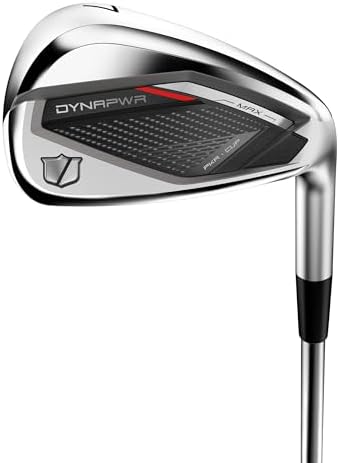
- Wilson DYNAPWR Max Men’s Steel Golf Irons – Right Hand, Regular, 5-PW, GW
- PKR-CUP FACE: Designed through AI simulation, PKR-Cup Face wraps the perimeter of the sole for maximum flex and consiste…
- OPEN HEEL CONSTRUCTION: Excess material in the heel is to fine tune center of gravity location.; SOUND OPTIMIZED: Topolo…
Cleveland Launcher XL Halo Irons
Cleveland built the Launcher XL Halo specifically for beginners and high handicappers who want hybrid-style performance in an iron package. The full-face design extends the usable hitting area significantly compared to a standard iron, and the hollow construction keeps weight low and back to promote high launch.
The Halo variant adds an adjustable sole that lets you fine-tune turf interaction without a trip to a fitter. For a beginner still figuring out their ball striking tendencies, this is a practical feature. If you tend to hit fat, you can open the sole slightly. If you catch it thin, close it down.
Pros: Maximum forgiveness, hybrid-style ease of use, adjustable sole, competitive price.
Cons: Very large head profile. Golfers who want to transition to traditional irons eventually may find it harder to adjust.
Callaway Big Bertha B21 Irons
Callaway designed the Big Bertha B21 to launch high and fight a slice, which describes a large percentage of beginner golfers. The offset hosel, wide sole, and draw-biased weighting combine to square the face at impact for players who struggle with the clubface being open at the point of contact.
If you are fighting a consistent slice, this iron specifically addresses the mechanical cause. The larger sole mixed with toe-side offset makes for a wide face at impact that maximizes forgiveness and helps beginners hit better strikes even on swings that are not quite right. It is a practical fix, not just a marketing claim.
Pros: Built-in slice correction, high launch, large sweet spot, strong distance.
Cons: Heavy offset is visible at address and may feel awkward as your swing improves and your natural shot shape changes.

- Due to unprecedented demand across the industry, causing a shortage of shafts and grip, we may need to substitute for an…
- Big Bertha B-21 is the first Big Bertha Iron with our A.I.-designed Flash Face Cup.
- This industry-leading Flash Face Cup is in each club. We’ve created high ball speeds and increased spin robustness with …
Srixon ZX4 Mk II Irons
The Srixon ZX4 Mk II sits at the better end of the game-improvement category. It is forgiving enough to help a beginner, but it has enough feel and feedback that you can grow with it as your handicap drops. Srixon’s hollow construction generates good ball speed, and the progressive design means the longer irons are more forgiving while the shorter irons have a tighter, more controlled feel.
This is the right pick for beginners who are improving quickly and do not want to buy two sets within two years. It bridges the gap between beginner-grade forgiveness and mid-handicapper performance better than most irons at its price point.
Pros: Good feel and feedback, grows with you as skill develops, strong value, progressive design works well across the bag.
Cons: Less forgiving than the super game-improvement options above. Not the best choice for very high handicappers or slower swing speeds.

- MAINFRAME MainFrame is a variable thickness pattern of grooves, channels, and cavities carefully milled into the backsid…
- HOLLOW IRON SHAPES Moderate sole width, our longest blade length, and our highest offset maximize the forgiveness of ZX4…
- PROGRESSIVE GROOVES The 4i–7i feature wide grooves, ideal for longer shots in all conditions. The 8i–AW have deeper, clo…
Takomo 101 MKII Irons
The Takomo 101 MKII is worth knowing about if budget is a hard constraint. Takomo is a direct-to-consumer brand that cuts out the retail markup entirely. The 101 MKII delivers ball speed and forgiveness that competes with irons costing twice as much from major brands. It is not as polished in fit and finish, and the brand name carries no status on the first tee, but the performance data holds up.
For a beginner who wants a full set without spending a thousand dollars, Takomo is one of the most honest options available. Check their website directly rather than Amazon for the most current models and pricing.
Pros: Excellent value, performance rivals premium brands, sold directly so no retail markup.
Cons: No brand recognition, less availability for hands-on demos before buying, limited fitting options.
Irons Beginners Should Avoid
Blade irons are for single-digit handicap players who hit the center of the face consistently. If you are new to the game, a blade iron will punish every off-center strike with a dead, unresponsive feel and a ball flight that goes nowhere. Players irons and muscle-backs fall into the same category. They look elegant and feel great when you hit them correctly, but that is precisely the problem. Beginners do not hit them correctly often enough for the design to work in their favor.
Also avoid very old iron sets, even name-brand ones. Technology in game-improvement irons has advanced substantially over the past decade. A 2010-era cavity back will not perform like a current model, and buying a used set of outdated irons to save money often costs you performance that would have meaningfully helped your development. If budget is tight, a recent used set from a reputable retailer is better than a cheap brand-new set of low-quality irons or an old set of name-brand clubs. Sites like Global Golf and 2nd Swing Golf sell certified pre-owned sets with condition grading.
Steel vs. Graphite Shafts: The Right Choice for Golf Irons for Beginners
Shaft material affects swing weight, feel, and how much help the club provides on slower swings. For golf irons for beginners, the default recommendation is graphite unless you have a specific reason to go otherwise.
Graphite shafts weigh less than steel, typically 50-70 grams versus 100-130 grams for steel. That weight difference makes it easier to swing faster, which translates directly to more distance. They also dampen vibration on mishits, which is a comfort advantage while your hands are still learning what a well-struck iron feels like.
Steel shafts make sense if your swing speed is above 85 miles per hour. At that speed, the additional feedback of a steel shaft becomes useful rather than punishing, and steel shafts are generally more consistent in flex profile across brands. Most men who played other sports and have good baseline athleticism swing fast enough for steel. If you are not sure, a launch monitor session at a local golf retailer will tell you your swing speed in ten minutes and costs nothing at most shops.
For women and seniors, graphite is almost always the correct choice regardless of swing speed, because the lighter total club weight reduces strain over the course of an 18-hole round.
How Many Irons Does a Beginner Actually Need
Most beginner iron sets sold at retail run from a 5-iron through a pitching wedge, which is six or seven clubs. That is the right range. A 3-iron and 4-iron require a consistent, well-developed swing to use effectively. Most beginners cannot get those clubs airborne reliably, and the frustration they cause is not worth the theoretical distance advantage.
A practical beginner iron setup looks like this: 5-iron, 6-iron, 7-iron, 8-iron, 9-iron, pitching wedge, and a gap wedge. That covers most distances you will face on the course. You can add a hybrid or fairway wood to handle the longer shots where a 3 or 4-iron would struggle. For more guidance on building a complete setup, see our article on golf game equipment and tips.
Is Custom Fitting Worth It for a Beginner
A full custom fitting session is not essential for a first iron set, but getting a few basics right matters more than most beginners think. Club length and lie angle affect where the sole of the club sits at impact, and a club that is too upright or too flat will produce consistent misses to the left or right regardless of how good your swing is.
At minimum, tell the retailer your height and wrist-to-floor measurement before buying. Most game-improvement irons are available in standard, one-inch over, or one-inch under lengths. Getting the length approximately right costs nothing extra with most brands. Lie angle adjustment is more involved but worth doing if you are more than an inch or two taller or shorter than average.
A full fitting session at a Ping, Callaway, or TaylorMade fitting center is worth considering once you have been playing for 6-12 months and your swing has stabilized. Fitting a swing that is still changing every week is less useful than fitting a more consistent motion. Most fitting sessions run $50-150 and are often credited toward a purchase.
Budget Guide for Golf Irons for Beginners
Iron prices vary significantly and the most expensive option is not always the right one for a new golfer. Here is a realistic breakdown of what your money gets you.
| Budget range | What you get | Best picks |
|---|---|---|
| Under $300 | New lower-tier game-improvement sets or quality used sets from recent years. Fine for someone testing the hobby. | Wilson DYNAPWR Max (sale), used Ping G series, used TaylorMade SIM Max |
| $300 to $600 | Current-generation game-improvement irons from major brands. This is where most beginners should be shopping. | Cleveland Launcher XL Halo, Callaway Big Bertha B21, Srixon ZX4 Mk II |
| $600 to $900 | Top-tier game-improvement and super game-improvement with better materials and fitting support. | Ping G730, TaylorMade Qi Max |
| Over $900 | Premium sets with extensive custom fitting options. Worth it if you are serious, not worth it if you are still learning whether you like the game. | Titleist T300, Cobra Darkspeed |

For most beginners, the $300-$600 range delivers everything you need. Spending more does not make you a better golfer. It makes you a golfer with expensive clubs. The swing mechanics that actually lower your score come from practice, not price tags. For a broader view of golf game gear worth buying, the golf game section on this site covers related equipment honestly.
New vs. Used Golf Irons for Beginners
Buying used is a legitimate and smart choice for a first set of irons, with one important condition: buy recent used, not old used. A three-year-old set of Ping G425 irons in good condition will outperform a new set of entry-level irons in every measurable way. The technology is better, the construction is better, and the name brand means you can resell them when you upgrade.
Avoid any iron set more than about seven or eight years old. The forgiveness and distance technology in current game-improvement irons represents a real step forward from what was available in 2015 or earlier. Old name-brand clubs are not a shortcut. They are old equipment that will not give you the help that a modern design provides.
Frequently Asked Questions About Golf Irons for Beginners
How many irons should a beginner carry in their bag?
A beginner needs six to seven irons: a 5-iron through pitching wedge, plus a gap wedge. Avoid 3-irons and 4-irons until your swing is consistent enough to get those clubs airborne reliably. Most beginners are better served replacing long irons with a hybrid or fairway wood, which is easier to launch and more forgiving on off-center contact. Golf rules allow 14 clubs maximum, but you do not need to fill every slot.
Should beginner golf irons have graphite or steel shafts?
Graphite is the right default for most beginners. Lighter shafts help slower swing speeds generate more clubhead velocity, which means more distance and easier launch. Steel shafts are worth considering if your swing speed exceeds 85 miles per hour, or if you have prior athletic experience and want more feedback from the club. Women and senior golfers should almost always choose graphite regardless of swing speed.
What loft should beginner irons have?
Most modern game-improvement and super game-improvement irons have stronger (lower) lofts than older iron designs. A 7-iron in a current game-improvement set might be lofted at 29-31 degrees rather than the traditional 34-35 degrees. That is not a problem. What matters is that the set has consistent gapping between clubs so each iron covers a distinct distance range. Ask the retailer about the full loft specification before buying to confirm even spacing.
Should I buy new or used irons as a beginner?
Used irons from the past three to five years are a strong value for beginners. A used set of Ping G425 or TaylorMade SIM Max irons in good condition will outperform a new budget set in forgiveness and ball speed. Avoid irons older than seven or eight years because the distance and forgiveness technology has improved significantly. Certified pre-owned retailers like Global Golf and 2nd Swing grade condition clearly so you know exactly what you are buying.
What is the difference between game-improvement and super game-improvement irons?
Game-improvement irons have a cavity back design with perimeter weighting that increases forgiveness over a players iron without making the club look oversized. Super game-improvement irons take that further with a larger head, wider sole, and more aggressive weighting designed for the maximum possible forgiveness. Game-improvement suits active beginners who plan to practice regularly. Super game-improvement suits casual players, seniors, slower swing speeds, and anyone who prioritizes keeping the ball in play over shot-shaping ability.
Is it worth getting a custom fitting for beginner golf irons?
A full custom fitting is not critical for a first set, but getting the length and lie angle approximately right is worth the effort. Tell the retailer your height and wrist-to-floor measurement before purchasing. Clubs that are too long or too upright produce consistent misses that have nothing to do with your swing. Once you have been playing for six to twelve months and your swing has stabilized, a proper fitting session is a worthwhile investment before buying your second set.
Can beginner golf irons help fix a slice?
Some beginner irons are specifically engineered to reduce a slice. The Callaway Big Bertha B21 uses draw-bias weighting and an offset hosel to help square the face at impact for players who struggle with an open clubface. That said, equipment adjustments reduce a slice, they do not cure it. A slice comes from swing path and face angle at impact. Lessons from a PGA professional will fix the underlying problem more durably than any iron design.
References
- MyGolfSpy iron testing methodology and 2025 super game-improvement iron results
- Golf Monthly: Best Golf Irons for Beginners 2026
- Golfmagic: Best Beginner Golf Irons 2026
- National Club Golfer: Best Irons for Beginners 2025
- Ping G730 product specification, Ping Golf official site
- Wilson Golf DYNAPWR Max technical specifications
About the Author
Chuck Wilson spent decades as a golf cart and small vehicle mechanic before retiring. His shop work covered Club Car, EZGO, and Yamaha platforms across gas and electric drivetrains. He runs GolfCartTips.com in retirement, writing about repairs, maintenance, and golf game equipment based on real experience, not manufacturer talking points. If a recommendation is on this site, it comes from someone who has actually used it.
Last verified: Golf equipment guide, May 2026. Models verified against current retail availability and independent testing data.