Golf Cart Etiquette on the Course: The Rules That Actually Matter
Golf cart etiquette is the set of rules and practices that protect the course, keep other players safe, and maintain the pace of play. Most of it comes down to three things: where you drive, how fast you drive, and how aware you are of what is happening around you. Get those three things right and you will rarely go wrong on any course. This guide covers the rules that matter most, with practical guidance for applying them in the situations where golfers most commonly get it wrong.
Last verified: Public, private, and resort course guidelines | May 2026 | Rules reflect USGA guidelines and standard course policies, confirm specific rules at the pro shop before each round
Key Takeaways
- The 90-degree rule is not just a courtesy, it is a practical turf protection measure. Fairway grass that takes repeated direct cart traffic develops wheel ruts and compaction that affects ball roll and course playability. The rule exists because the damage is cumulative and expensive to repair. A course that enforces the 90-degree rule consistently maintains fairway quality far longer than one that does not.
- Cart path only days are not a punishment. They are implemented when the moisture content of the turf is high enough that cart traffic would cause compaction damage that takes weeks to recover. The decision is made by the grounds crew based on soil conditions, not arbitrary scheduling. Driving on the fairway when cart path only is in effect causes the specific type of deep soil compaction that the rule is designed to prevent.
- Golf cart etiquette varies between private and public courses in ways that are not always posted. Private courses typically have stricter rules about cart access near tees and greens. Resort courses may allow closer access to accommodate guests unfamiliar with the layout. The safest approach on any unfamiliar course is to stop at the pro shop, ask about cart rules before teeing off, and check the scorecard for any written guidelines.
Golf Cart Etiquette Rule 1: The 90-Degree Rule
The 90-degree rule is the most important golf cart etiquette rule for fairway management. It works like this: drive along the cart path until your cart is level with your ball’s position on the fairway, then turn 90 degrees and drive straight to your ball. After hitting, drive straight back to the path at 90 degrees and continue to the next position. You do not drive diagonally across the fairway to reach the ball and you do not weave through the fairway looking for balls.
The reason for the right-angle approach is traffic distribution. If every golfer in a round takes a diagonal path across the fairway, the total cart traffic across the grass is maximized and concentrated in the same areas. If everyone uses the 90-degree approach, carts leave the path at many different points across the length of the fairway and the wheel traffic is spread across the full width of the turf. The total tire contact with the grass is similar but the compaction is distributed rather than concentrated, which allows the turf to recover between rounds.
Some courses suspend the 90-degree rule during wet conditions and go cart path only. When the course staff makes this call, they are telling you the fairway turf is at a moisture level where any wheeled traffic causes the kind of deep soil compaction that takes weeks to correct. Ignoring cart path only to use the 90-degree rule instead is not a middle ground, it causes exactly the damage the rule is trying to prevent.
The information board at the first tee or pro shop will show the day’s cart policy. Look for signs indicating 90-degree rule, cart path only, or fairways open. If nothing is posted and no staff are available, default to cart path only as the conservative choice.
Golf Cart Etiquette Rule 2: No-Cart Zones
Every course has areas where carts are never permitted regardless of the day’s general cart policy. These no-cart zones exist because the turf in those areas cannot tolerate wheeled traffic without significant and long-lasting damage.
Tee boxes are always no-cart zones. The grass on a tee box takes heavy foot traffic from golfers teeing off on every single round. Adding cart tire traffic to a tee box would destroy the surface within weeks. Park the cart on the path near the tee box, walk to the tee, hit, walk back to the cart.
Greens and the collar around greens are always no-cart zones. Green turf is maintained at extremely low mowing heights, typically under 0.125 inches, which leaves almost no blade structure to absorb impact. A cart tire on a green leaves a compressed track that affects the putting surface for multiple rounds. Most courses enforce a 30-foot buffer zone around greens. Learn to visually identify where the collar ends and stay well clear of it.
Bunkers are no-cart zones. The sand in a bunker does not support cart traffic and the edges are particularly vulnerable to collapse from the weight of a cart. Beyond the damage caused, a cart near a bunker creates a safety risk if the ground at the bunker edge is soft.
Many courses also have roped-off areas near fairways or on slopes where the turf is recovering from previous damage or where the grade makes cart operation unsafe. When you see rope barriers or stake lines, they mark a no-cart zone for that day regardless of the general cart policy in effect. Do not cross them.
Golf Cart Etiquette Rule 3: Speed and Safe Driving
Most courses post a maximum cart speed of 10 to 15 mph. These limits exist because golf cart rollover accidents are a significant source of injury on courses. Golf carts have a high center of gravity relative to their track width, and their stability on slopes is limited. A sharp turn at speed on a cart path or slope is one of the most common causes of rollover incidents.
The practical speed rules for golf cart etiquette on the course are straightforward. Drive at a speed that allows you to stop well within the distance you can see. On blind corners of cart paths, slow down before the corner, not after. On slopes, drive straight up or straight down, never across a steep slope at an angle, which puts the weight of the cart on the downhill wheels and significantly reduces stability.
If the slope feels steep enough that you are unsure, get out and walk. For a full breakdown of golf cart safety practices including rollover prevention and seatbelt use, see our golf cart safety tips guide.
Keep the cart away from other players while they are addressing the ball. Drive to a position that is behind or well to the side of the player before they begin their pre-shot routine. The noise and movement of a cart in the peripheral vision of a player is distracting and is one of the most common complaints about golf cart etiquette on public courses. Stop the cart, wait for the shot, then move.
Keep all body parts inside the cart while it is moving. Hanging legs or arms outside the cart during a rollover creates serious injury risk. This is particularly relevant for passengers, who may sit sideways or with legs draped over the side, especially when the cart is being driven slowly between shots.
Golf Cart Etiquette Rule 4: Pace of Play
A golf cart is supposed to speed up the pace of play. Misused, it does the opposite. The most common pace of play problem caused by golf cart etiquette failures is the two-player cart that drives both players to one ball, waits for that player to hit, then drives to the other ball. On a par four where both players’ balls are on opposite sides of the fairway, this approach can add five minutes to a single hole compared to each player walking to their own ball or using ready golf cart positioning.
The ready golf approach to cart positioning is: drop your playing partner at their ball with their club selection and drive to your own ball while they prepare to hit. You hit while they hit or immediately after. Then one of you drives the cart to whoever is furthest from the hole and repeats.
This approach, combined with being ready to hit when it is your turn rather than waiting until you arrive at your ball to assess distance and club selection, keeps the pace moving and is considered proper golf cart etiquette on well-managed public and private courses. For a complete guide to keeping your cart in top shape for a full season of rounds, see our golf cart maintenance checklist.
Be aware of the group behind you. If you are falling more than one clear hole behind the group ahead and the group behind is waiting at each tee, the course marshal will ask you to speed up or let the group behind play through. Neither outcome is pleasant. A group that is managing its cart positioning correctly rarely has pace of play issues.
Golf Cart Etiquette Rule 5: Cart Path Relief Procedure
When your ball comes to rest on a cart path, you are entitled to free relief under the Rules of Golf. The procedure is specific and worth knowing before you need it.
Find the nearest point of complete relief from the cart path that is not nearer the hole. This means the point where you could take a normal stance and swing without the cart path interfering with your ball, your stance, or your intended swing area. The nearest point of relief may be on either side of the path, you do not get to choose the most favorable side, only the nearest point. Drop within one club length of that point, no nearer the hole, and play from the dropped position.
A common mistake is taking relief to a position that is technically off the path but still has the path interfering with the stance or swing. The relief must be complete, ball, stance, and swing area all clear. If the nearest point of complete relief puts you in a worse lie than where the ball was originally, you still must take relief at that point. You do not get to choose to play from the path just because the relief position is less favorable.
The USGA Rules of Golf cover the full cart path relief procedure under Rule 16.1. For the complete rule text and examples, the USGA Rule 16.1 page covers every scenario including when the nearest point of relief would put the ball out of bounds.
Golf Cart Etiquette Rule 6: Course-Specific Policies
Golf cart rules vary between course types in ways that go beyond the standard 90-degree rule and no-cart zones. Private, public, resort, and municipal courses each operate under different priorities that shape their cart policies.
| Course Type | Typical Cart Policy | Common Variations |
|---|---|---|
| Private | Strict, membership-level enforcement of all rules | May restrict carts near tees and greens more tightly than public courses |
| Public | Standard 90-degree rule or cart path only depending on conditions | May be more lenient near greens to accommodate guest traffic volume |
| Resort | Generally permissive to enhance guest experience | May allow closer access to features not permitted at standard courses |
| Municipal | General guidelines aimed at turf preservation and safety | High traffic volume may mean stricter cart path requirements during peak periods |
The most reliable source for a course’s cart rules on any given day is the staff member at the first tee or the pro shop. The scorecard often contains printed cart rules. Some courses use signage at each hole to indicate whether the fairway is open that day. Courses with GPS-equipped carts, like those using the TagMarshal GPS system, may display the day’s cart rules on the cart’s screen and can alert players who drive into restricted areas automatically.
When playing a private course as a guest, follow your host’s lead and do not assume the rules are the same as the public course you played last week. Private course members are generally very familiar with their specific rules and will tell you if you are about to do something wrong. If in doubt, ask.
Golf Cart Etiquette Rule 7: Parking and Positioning Near the Green
Where you park the cart at the green is one of the most visible golf cart etiquette behaviors on the course. The wrong positioning slows down play for your group and for the group behind you.
Park the cart on the side of the green that is closest to the next tee, not on the side you approached from. This means you exit the green and walk directly to the cart rather than crossing the green or walking around it after holing out. It saves time on every hole and means the group behind can walk onto the green while you are already moving toward the next tee.
Do not park directly behind the hole on the putting green. A cart parked in a player’s line of sight or behind the hole is distracting during putting. Position the cart to the side and at least 30 feet from the green edge.
When the group ahead is still on the green, hold your cart position at a distance that does not crowd them. The etiquette standard is to wait until the group ahead has holed out and is clearing the green before you approach. Pulling the cart up to the green fringe while another group is still putting is considered poor etiquette on both public and private courses.
Golf Cart Etiquette Rule 8: First-Time Driver Checklist
If you are driving a golf cart for the first time or playing a course you have not played before, run through this checklist before you tee off.
- Ask at the pro shop about today’s cart policy, 90-degree rule, cart path only, or fairways open. Do not assume from the last time you played.
- Check the scorecard for printed cart rules and any course-specific no-cart zones that are not standard.
- Identify where the no-cart zones are near each green before you approach. Most courses mark them with white stakes or rope barriers.
- Practice the pedal feel before you leave the cart staging area. Golf cart throttle response varies between models and between gas and electric.
- Wear your seatbelt and instruct your passenger to do the same before moving.
- Do not allow passengers to sit sideways or with legs outside the cart while moving.
- Never leave the cart running unattended on a slope. Apply the parking brake.
- Approach hills straight up or straight down. Never traverse a steep slope at an angle.

- Retractable seat belt bracket Kit fits most 4 passenger (2+2 rear seat), such as EZGO TXT RXV, Club Car DS Precedent and…
- DOT-approved seat belts, sturdy brackets, make your cart legal for street use and keep passengers more safty while the v…
- Retractable Belt length: 42″, Bracket size: 35″ x 6.9″, Seat Belts with buckles made in metal zinc. It’s convenient and …
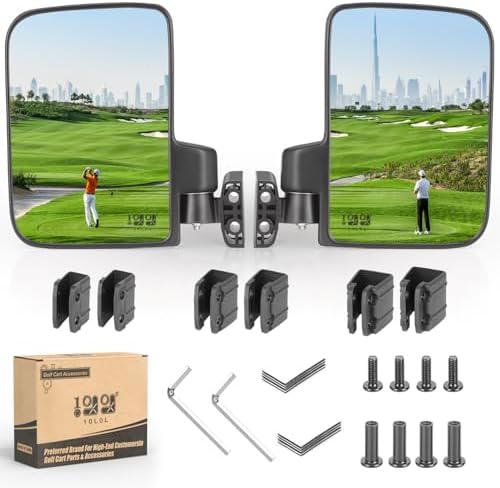
- Universal Golf Cart Side Mirrors: Our side mirror fit for golf carts with 0.75/1/1.25 inch square tube roof bracket with…
- No-Drilling Required: Our rear view mirror no drilling, no need to find tools, no need to worry about inconsistent drill…
- Not Suitable Golf Cart: 1. Not suitable for golf cart with one piece windshield; 2. Not suitable for round tube roof bra…
Universal fit rearview mirror for golf carts. Improves awareness of other carts and players approaching from behind on busy public courses.
View on Amazon →

Frequently Asked Questions About Golf Cart Etiquette
What is the 90-degree rule in golf?
The 90-degree rule requires golfers to drive along the cart path until their cart is level with their ball, then turn at a right angle and drive straight to it. This distributes cart traffic across the width of the fairway rather than concentrating it on diagonal paths, which reduces compaction and turf wear. The rule is suspended on cart path only days when fairway moisture is high enough that any cart traffic would cause damage.
What does cart path only mean?
Cart path only means the course has restricted all golf cart traffic to the paved cart paths for the day. It is implemented when soil moisture is high enough that cart tires would cause deep compaction damage to the fairways. It is not a punishment for bad weather, it is a grounds management decision made to protect the course. On cart path only days, you must walk from the path to your ball and back regardless of the distance.
How do I take relief from a cart path?
Find the nearest point of complete relief from the cart path that is not nearer the hole. Drop within one club length of that point, no nearer the hole. The relief must eliminate interference with your ball, your stance, and your intended swing area. You cannot choose the side of the path, you must use the nearest point. If the nearest point gives you a worse lie, you still take relief there or choose to play from the path without relief.
How far should a golf cart stay from the green?
The standard buffer is 30 feet from the edge of the green, though individual courses may specify a different distance. Beyond the no-cart buffer, park on the side of the green closest to the next tee so your group can exit directly toward the next hole after putting out. Do not park behind the hole in another player’s line of sight.
What are the main differences between private and public course cart rules?
Private courses generally enforce stricter cart rules than public courses, with tighter restrictions near tees and greens and more consistent enforcement of the 90-degree rule. Public courses typically apply the same rules but enforcement varies more. Resort courses tend to be more permissive to accommodate guests. Municipal courses often have high traffic volume that requires stricter cart path rules during peak periods. Always ask at the pro shop before teeing off on an unfamiliar course.
About the Author
Chuck Wilson spent decades as a golf cart and small vehicle mechanic before retiring. His shop work covered Club Car, EZGO, and Yamaha platforms across gas and electric drivetrains. He runs GolfCartTips.com in retirement, writing about repairs and maintenance based on jobs he has actually done, not manufacturer talking points. If a procedure is on this site, it has been performed on a real cart.
Cart path relief procedure sourced from USGA Rules of Golf Rule 16.1, current 2023 edition. Course type policy comparisons reflect standard industry practice as of May 2026.