Best Golf Cart Battery: Lead-Acid, AGM, and Lithium Compared
The best golf cart battery depends on your budget, how long you plan to keep the cart, and how much maintenance you are willing to do. Flooded lead-acid is the cheapest entry point but requires regular watering and degrades faster. AGM is a sealed, lower-maintenance upgrade at a moderate price increase. Lithium LiFePO4 costs the most upfront but lasts 8 to 10 years, weighs less, and delivers consistent power from full charge down to near empty. Know what you are buying before you open your wallet.
Last verified: Gas and electric carts, all major platforms (EZGO, Club Car, Yamaha) | May 2026 | Trojan T-605 6V, Battle Born 48V 100Ah, Dakota Lithium 48V
Key Takeaways
- Mixing battery brands or ages in a pack is a mistake that kills your whole string within one season. When one cell goes weak, it drags every other battery down during discharge. Replace the full pack at the same time, with batteries from the same production run if possible.
- Lithium conversions require a charger profile change. A lead-acid charger will undercharge a lithium pack and shorten its life, or in some cases damage it. Budget for a new charger when switching chemistry, and verify that your charger supports the voltage profile for LiFePO4.
- Upfront cost comparisons between lead-acid and lithium are misleading unless you factor in lifespan. A flooded lead-acid pack that costs $600 and lasts 4 years costs more per year than a $1,500 lithium pack that lasts 10. Run the math for your specific cart before deciding.
How Golf Cart Batteries Are Different From Car Batteries
Golf cart batteries are deep-cycle batteries. A car battery delivers a large burst of current for two seconds to start the engine, then the alternator takes over. A golf cart battery delivers moderate current continuously for 45 minutes to several hours. That cycling pattern — deep discharge followed by a full recharge — is what deep-cycle chemistry is built for. Use a starting battery in a golf cart and you will destroy it in one season. The plates are not designed for deep discharge and will shed active material quickly.
Most carts run on 36V or 48V systems built from banks of 6V, 8V, or 12V batteries wired in series. Series wiring means the voltages add while the capacity stays the same. Six 6V batteries in series gives you 36V. Six 8V batteries gives you 48V. Eight 6V batteries also gives you 48V. Always verify your pack voltage and battery count before buying replacements, and always wire replacements in series the same way the originals were wired.
Flooded Lead-Acid: Low Cost, Higher Maintenance
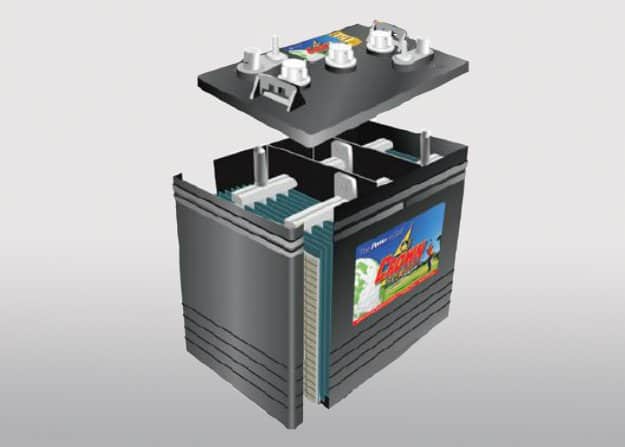
Flooded lead-acid (FLA) batteries are the traditional choice. The Trojan T-605 6V is the most commonly referenced option for good reason: it has a long track record in golf carts, handles the deep-cycle demands of cart use reliably, and Trojan’s quality control is consistent. These batteries are available at most battery shops and golf cart dealers, which matters when one goes bad mid-season and you need a same-day replacement.
The trade-off is maintenance. Flooded lead-acid batteries have liquid electrolyte that vaporizes during charging. Every 30 days during active use, check the water level in each cell and top off with distilled water only. Tap water contains minerals that contaminate the electrolyte and accelerate plate corrosion. Fill to just above the plates. Do not overfill or you will force electrolyte out during charging, corrode your battery tray, and lose capacity.
Lifespan for a well-maintained flooded lead-acid pack in a golf cart is typically 4 to 6 years. Neglected packs that run low on water, sit discharged for weeks, or get charged with a faulty charger will not make it to 3 years. Temperature matters too. Heat accelerates grid corrosion and water loss. If you store your cart in a hot garage in the summer, check water levels more frequently than monthly.
If you want to test whether your current flooded batteries are still holding up, the right tool is a hydrometer, not just a voltmeter. A voltmeter tells you surface charge. A hydrometer measures specific gravity — the actual concentration of sulfuric acid in the electrolyte — which tells you the true state of charge and flags a weak or dead cell. You can also test your golf cart batteries with a load tester to confirm capacity under real discharge conditions.
AGM: The Sealed Middle Ground
AGM stands for Absorbed Glass Mat. Instead of free liquid electrolyte, AGM batteries use a fiberglass mat saturated with electrolyte held between the plates. The battery is sealed. No watering, no acid fumes, no risk of spilling if the tray cracks or tips.
For cart owners who want something better than flooded lead-acid without the price of lithium, AGM is a reasonable step up. These batteries handle vibration better than flooded cells, which matters if your course has rough paths or you use the cart on uneven terrain. They also tolerate deeper discharges slightly better than flooded cells, though you should still avoid regularly discharging below 50 percent state of charge if you want maximum lifespan.
AGM batteries typically cost 20 to 40 percent more than equivalent flooded lead-acid. Lifespan is similar — 4 to 6 years in cart service — though some owners report slightly longer service in moderate climates. The main advantage is the elimination of maintenance and the sealed construction. If you store the cart in an enclosed space where acid fumes would be a concern, AGM is worth the price difference over flooded.
One common mistake with AGM batteries: charging them with a charger set to the flooded lead-acid voltage profile. AGM batteries have a lower charge voltage ceiling. Overcharging an AGM battery with a flooded-profile charger will dry out the mat, reduce capacity irreversibly, and shorten the battery’s life. Verify that your charger has an AGM-specific setting, or use a smart charger that detects battery chemistry automatically.
Lithium LiFePO4: Best Performance, Highest Upfront Cost
Lithium iron phosphate (LiFePO4) batteries are the best performing option currently available for golf carts. The chemistry is stable, the cycle life is long, and the discharge curve is nearly flat — meaning your cart runs at close to full power until the battery is nearly depleted, rather than slowing progressively as the pack drains. That flat discharge curve is immediately noticeable if you have been used to lead-acid packs.
Weight reduction is significant. A set of six Trojan T-605 6V flooded lead-acid batteries weighs roughly 390 pounds. A 48V lithium drop-in pack typically weighs 60 to 80 pounds. That weight reduction improves range, reduces wear on the suspension and tires, and makes the cart more responsive on inclines. If your course has significant elevation changes, that difference is not minor.
Cycle life for LiFePO4 is rated at 2,000 to 5,000 full charge cycles depending on the specific product. In cart use, a cycle is one full discharge and recharge. If you cycle the cart once a day during the golf season, a conservative estimate puts the battery lifespan at 8 to 12 years before capacity drops to 80 percent. Most lead-acid packs are gone in 4 to 5 years under the same usage pattern.
The upfront cost is the obstacle for most buyers. A quality 48V lithium drop-in pack runs $1,200 to $2,000 depending on capacity and brand. A flooded lead-acid pack for the same cart runs $500 to $700. The lithium pack will outlast two lead-acid replacements in most use cases. Over a 10-year horizon the lithium option frequently comes out cheaper once you factor in replacement costs and the time and materials spent on lead-acid maintenance.
The critical requirement with lithium is charger compatibility. A standard lead-acid charger will not charge a lithium pack correctly. The charge algorithm is different. Most lithium manufacturers either include a compatible charger or sell one separately. Do not assume your existing charger will work. Charger incompatibility is the single most common cause of early lithium pack failure reported by cart owners. Verify compatibility before you buy.
Cost Comparison Over a 10-Year Window
Comparing upfront price alone is how people end up disappointed with their purchase. The table below uses conservative lifespan estimates and typical retail pricing. Your numbers will vary depending on cart usage, climate, and maintenance habits, but the structure of the comparison is consistent.
| Battery Type | Pack Cost | Lifespan | Replacements (10 yr) | Total 10-Year Cost |
|---|---|---|---|---|
| Flooded Lead-Acid | $600 | 4 years | 2 (at year 4 and 8) | ~$1,800 |
| AGM | $850 | 5 years | 1 (at year 5) | ~$1,700 |
| Lithium LiFePO4 | $1,600 | 10+ years | 0 | ~$1,600 |

These numbers do not include the cost of a new charger if you switch to lithium (typically $150 to $300) or the time spent on lead-acid maintenance. They also do not account for the fuel savings from reduced weight on electric carts, which improves range per charge. The lithium total is conservative and assumes no replacement within the 10-year window. Many lithium packs in golf cart service outlast that estimate.
Platform-Specific Notes for EZGO, Club Car, and Yamaha
Battery fitment is not universal. Before buying any replacement pack, confirm the battery tray dimensions, the number of batteries your system uses, and the system voltage. A wrong-voltage pack will damage your controller or charger immediately.
EZGO TXT (48V electric): Uses six 8V batteries in series. Compartment dimensions are tight. Verify that any lithium drop-in kit specifies EZGO TXT compatibility, as the case dimensions differ from Club Car.
Club Car DS and Precedent (48V): DS models typically use six 8V or four 12V batteries. Precedent uses a different battery tray configuration. Confirm which generation you have before purchasing a lithium kit, as tray dimensions are not interchangeable between the two models.
Yamaha Drive and Drive2: Most electric Drive models run 48V with six 8V batteries. Drive2 models may use a different charger port. If you are switching to lithium on a Drive2, confirm that the OBC (onboard computer) is compatible with the lithium charging profile, as some Drive2 OBC units flag lithium charge curves as faults.
36V systems (older carts): Some older EZGO and Club Car models run 36V using six 6V batteries. Lithium drop-in kits exist for 36V systems but are less commonly stocked. Verify availability before committing to a lithium upgrade on an older cart. Also confirm that the charger supports 36V lithium profiles.
If you are unsure of your cart’s system voltage, a simple way to check is to count the cells. Each 6V flooded battery has 3 cells (3 vent caps). Each 8V battery has 4 cells. Count the total cells across the pack and multiply by 2 to get pack voltage. Six 8V batteries: 6 x 4 = 24 cells x 2 = 48V. This method works on any flooded pack.
Maintenance Requirements Side by Side
Knowing what each battery type demands from you monthly and seasonally will help you make the right call based on how you actually use the cart, not just on paper specs.
Flooded lead-acid: Check water levels monthly during the golf season. Top off with distilled water only. Clean terminal corrosion with a wire brush and baking soda solution. Keep the cart on a maintenance charger during storage to prevent sulfation. Fully charge the pack before storing for winter. Check specific gravity with a hydrometer annually.
AGM: No watering. Keep terminals clean. Use an AGM-compatible charger. Store with a full charge. Avoid deep discharges below 50 percent consistently. AGM batteries that are regularly deep-discharged lose capacity faster than their rated lifespan suggests.
Lithium LiFePO4: Essentially maintenance-free. No watering, no terminal corrosion from outgassing. Built-in battery management system (BMS) handles overcharge and over-discharge protection. Keep the pack stored at 50 to 80 percent state of charge during long-term storage rather than fully charged. Use only the compatible charger.
If your cart has a golf cart battery meter installed, it will give you a rough state-of-charge reading regardless of battery chemistry. Note that meters calibrated for lead-acid voltage curves will read inaccurately on a lithium pack. Lithium-specific meters or smart displays that ship with lithium kits read the BMS output directly and are more accurate.
Which Battery Should You Buy
If you are on a tight budget, the cart is old, and you are not sure how much longer you will use it: flooded lead-acid. Buy a quality brand like Trojan, keep up with the water, and replace the full pack when the first battery starts lagging behind the others.
If you want less maintenance and can spend modestly more: AGM. Sealed, no watering, and handles the cart environment well. Make sure your charger supports AGM profiles.
If you plan to keep the cart for 8 or more years, want the best performance, and are willing to pay more upfront: lithium. Budget for a compatible charger as part of the conversion cost. The long-term economics are solid if the cart is going to stay in service.
Whatever you choose, replace the full pack at once. Mixing old and new batteries, or mixing brands, creates an unbalanced pack where the weaker batteries discharge faster and drag the stronger ones down. One weak battery in a series string degrades the effective capacity of the whole pack. This is one of the most common ways a $600 battery purchase turns into a $600 mistake six months later.
Frequently Asked Questions
What type of battery is best for a golf cart?
Lithium LiFePO4 batteries offer the best combination of performance, lifespan, and low maintenance for golf cart use. If budget is the primary constraint, flooded lead-acid batteries from a quality brand like Trojan remain a reliable and well-supported option. AGM falls between the two on cost and maintenance requirements.
How long do golf cart batteries last?
Flooded lead-acid and AGM batteries typically last 4 to 6 years with proper maintenance. Lithium LiFePO4 batteries typically last 8 to 12 years. Lifespan shortens significantly with neglect, deep storage without a maintenance charge, or use of an incompatible charger.
Can I replace lead-acid with lithium in my golf cart?
Lithium drop-in replacement kits are available for most major cart platforms including EZGO, Club Car, and Yamaha. You must replace your charger with one that supports the lithium charge profile. Do not use a lead-acid charger on a lithium pack.
Is a higher Ah battery better for a golf cart?
Higher amp-hour (Ah) capacity means more energy storage, which translates to longer range per charge. Within the same battery chemistry, a higher Ah rating is generally better for cart use as long as the battery physically fits the tray and matches the system voltage. Do not increase voltage in pursuit of more capacity; voltage must match your charger and controller specifications exactly.
Should I use distilled water or tap water in my golf cart batteries?
Distilled water only. Tap water contains minerals and chlorine that contaminate the electrolyte, accelerate plate corrosion, and shorten battery life. Distilled water is available at any grocery store for under $2 a gallon and there is no substitute for it in flooded lead-acid batteries.
About the Author
Chuck Wilson spent decades as a golf cart and small vehicle mechanic before retiring. His shop work covered Club Car, EZGO, and Yamaha platforms across gas and electric drivetrains. He runs GolfCartTips.com in retirement, writing about repairs and maintenance based on jobs he has actually done, not manufacturer talking points. If a procedure is on this site, it has been performed on a real cart.
Last verified on: EZGO TXT 48V, Club Car Precedent 48V, Yamaha Drive 48V. Battery chemistry comparisons cross-referenced against Trojan, Battle Born, and Dakota Lithium product documentation.