How to Choose a Golf Cart Trailer: Size, Weight, Hitch, and Safety Explained
A golf cart trailer purchase goes wrong in one of four ways: the trailer is too short for the cart, the tow vehicle cannot handle the combined weight, the ramp angle is too steep for the cart’s low clearance, or the tie-downs are undersized for the load.
This guide covers all four problems with specific numbers, trailer dimensions against cart dimensions, hitch class ratings against combined weights, ramp angle calculations, and tie-down strap ratings. It includes a complete weight table for 40 EZGO, Club Car, and Yamaha models so you can calculate your exact towing requirement before you buy anything.
Last verified: EZGO, Club Car, and Yamaha published specifications | May 2026 | Weight figures are manufacturer-published curb weights, verify against your specific model configuration
Key Takeaways
- Width is the critical dimension, not length. Most golf carts are 47 to 51 inches wide. A 5-foot wide trailer deck (60 inches) gives you only 4.5 to 6.5 inches of clearance on each side. A 6-foot wide deck is significantly more forgiving to load, especially with lifted carts, wider aftermarket tires, or side mirrors. Never buy a trailer based on length alone without measuring your cart’s width against the trailer deck width.
- The ramp angle determines whether your cart can actually get onto the trailer. A cart with stock clearance of 4 inches cannot drive up a ramp steeper than about 15 degrees without dragging the frame. Calculate ramp angle before buying: divide the trailer deck height by the ramp length and take the inverse sine. A 24-inch deck height with a 10-foot ramp gives a 11.5-degree angle. A 24-inch deck with a 6-foot ramp gives a 18.4-degree angle. Lifted carts have more clearance and tolerate steeper ramps. Stock carts need longer ramps or a tilt-bed trailer.
- Your tow vehicle’s hitch class and towing capacity must cover the combined weight of the trailer plus the loaded cart. An empty trailer rated at 1,500 lbs GVWR with a 500 lb dry weight can carry 1,000 lbs of cargo. Add the cart’s curb weight and you have your tow vehicle requirement. A Honda HRV with a Class I hitch is rated for 1,500 lbs total towing. A 500 lb trailer plus a 970 lb EZGO TXT Electric puts you 30 lbs under the limit with no passengers, tools, or accessories on the cart. A Class II hitch raises the limit to 3,500 lbs and gives you real margin.
Golf Cart Trailer Types: Open Utility, Enclosed, and Tilt Bed
Three trailer types cover the vast majority of golf cart transport needs. Choosing the right type depends on how often you transport, how far you travel, what weather you drive through, and how much clearance your cart has for loading.
Open Utility Trailers
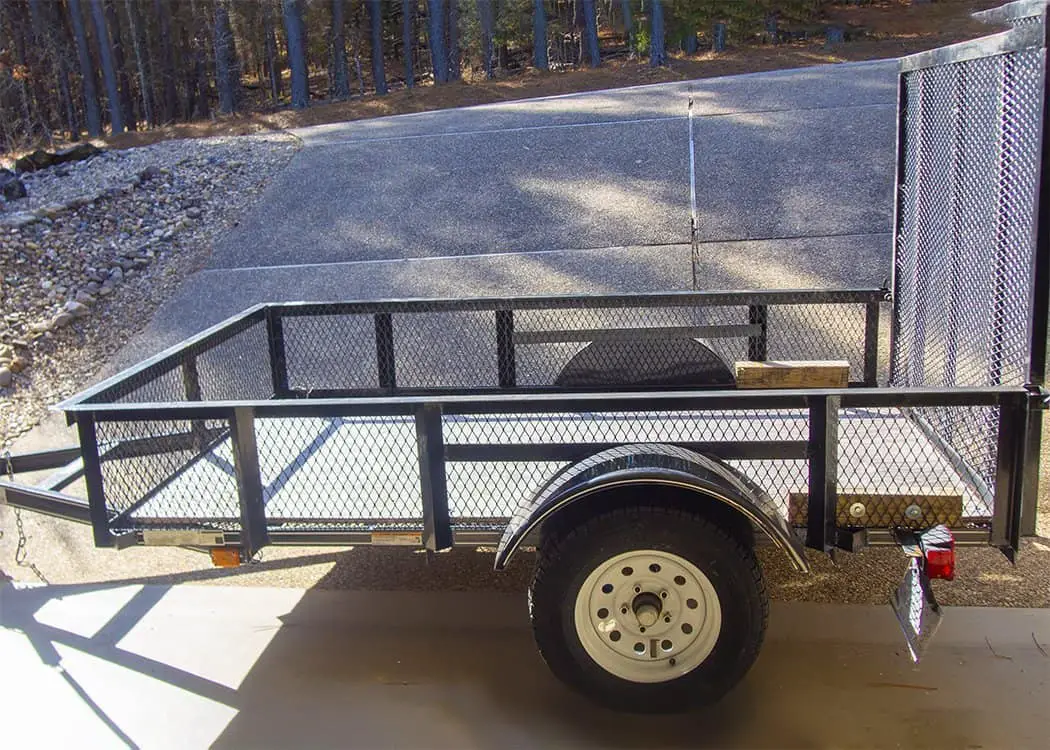
Open utility trailers are the most common and most practical choice for most golf cart owners. They are lighter than enclosed trailers, which means more of the tow vehicle’s capacity is available for the cart’s weight. They load from a fold-down rear ramp or gate. Deck heights on typical utility trailers run 18 to 28 inches depending on axle configuration and tire size. Single-axle utility trailers in the 5×10 to 6×12 range cover nearly every standard two-seat golf cart without issue.
The main limitation is weather exposure. A cart transported regularly on open trailers will accumulate road grime on the undercarriage and seat upholstery, and extended highway exposure accelerates weathering on vinyl and plastic components. For occasional local transport, this is a non-issue. For regular long-distance hauling, an enclosed trailer is worth the additional cost.
Steel utility trailers are cheaper than aluminum but heavier and require more maintenance to prevent rust at weld points and frame surfaces. A galvanized or powder-coated steel trailer stored outdoors in a wet climate will rust at the welds within 5 to 8 years without maintenance. An aluminum trailer costs 20 to 40 percent more but will outlast the cart in most conditions with minimal maintenance beyond keeping the hardware tight.
Enclosed Trailers
Enclosed trailers protect the cart from road debris, weather, and UV exposure during transport and provide secure storage between uses. For cart owners who travel to out-of-state events, use the cart seasonally, or want to lock the cart away when stored, an enclosed trailer is the premium option. The trade-off is weight. A 6×12 enclosed trailer weighs 1,500 to 2,000 lbs empty, which significantly reduces the available payload for the cart. Confirm your tow vehicle’s capacity covers both the trailer weight and the cart’s curb weight before buying an enclosed trailer.
Interior height matters on enclosed trailers if your cart has a top. Most standard golf cart tops extend to around 70 to 75 inches from the ground. A 6-foot interior height enclosed trailer will not clear a cart with the top on. Verify interior height against your cart’s total height before purchasing. A 7-foot interior height is the minimum for most carts with tops.
Tilt Bed Trailers
Tilt bed trailers solve the ramp angle problem entirely. The entire trailer bed tilts to ground level, allowing the cart to drive directly onto the deck without any ramp. This is the best solution for stock-clearance carts that cannot handle steep ramps and for owners who load and unload the cart alone without assistance. The deck angle when tilted is typically 5 to 8 degrees, which every stock cart can handle without issue.
The limitation of tilt trailers is that the tilting mechanism adds weight and mechanical complexity compared to a fixed-deck trailer. The pivot and lock mechanism requires periodic inspection to confirm it is latching fully before towing. A tilt deck that is not fully latched will shift under braking. Check the lock engagement every time before departure.
Golf Cart Trailer Size: Width First, Then Length
Most guides tell you to start with trailer length. Start with width. Width is where most fitment problems happen. A cart that is 48 inches wide on a 60-inch wide trailer deck (5 feet) has 6 inches of total clearance, 3 inches on each side. That is tight enough that a slight misalignment during loading can put a wheel over the edge of the deck. A 72-inch wide deck (6 feet) gives you 12 inches total, 6 inches per side, which is much more forgiving.
Standard two-seat golf carts from EZGO, Club Car, and Yamaha run 47 to 49 inches wide at the body. Carts with wider aftermarket tires, side mirrors for street-legal use, or extended rear seat kits may run 52 to 56 inches wide. Measure your cart at its widest point, including mirrors if fitted, before selecting a trailer width.
For length, add 12 inches to the cart’s overall length for loading and tie-down clearance. A standard EZGO TXT at 93 inches long needs a 105-inch minimum deck, an 8.75-foot deck. A 10-foot (120-inch) deck is the practical minimum for most standard two-seat carts and gives adequate room to position the cart and attach tie-downs at the front and rear. Four-seat carts and six-seat carts running 114 to 161 inches long need 12 to 14-foot decks.
| Cart Configuration | Typical Width | Typical Length | Minimum Trailer Width | Minimum Deck Length |
|---|---|---|---|---|
| Standard 2-seat (EZGO TXT, Club Car DS, Yamaha Drive) | 47-49 in. | 92-94 in. | 60 in. (5 ft) | 10 ft |
| 2-seat with mirrors/wide tires | 52-56 in. | 92-94 in. | 72 in. (6 ft) | 10 ft |
| 4-seat (2+2 models) | 47-50 in. | 105-115 in. | 60 in. (5 ft) | 12 ft |
| 6-seat (stretch/concierge models) | 47-52 in. | 135-165 in. | 72 in. (6 ft) | 14 ft |
Golf Cart Trailer Ramp Angle: The Number Most Guides Skip
Ramp angle is the single most overlooked specification in golf cart trailer buying guides. A ramp that is too steep will drag a stock cart’s frame on the way up, potentially damaging the undercarriage and making loading dangerous. Stock golf carts typically have 4 to 6 inches of ground clearance. Lifted carts have 8 to 12 inches.
The maximum safe ramp angle for a stock-clearance cart is approximately 15 degrees. Above that, the rear of the cart’s frame contacts the ramp before the rear wheels are on the deck. To calculate the ramp angle: divide the deck height in inches by the ramp length in inches, then multiply by 57.3. A 24-inch deck height and a 96-inch (8-foot) ramp: 24 divided by 96 equals 0.25, multiplied by 57.3 gives approximately 14.3 degrees, which is within the safe range for stock carts.
The same 24-inch deck height with a 72-inch (6-foot) ramp gives 19 degrees, which is too steep for stock clearance carts. When evaluating trailers, always ask or measure the deck height and the ramp length and run this calculation before buying. Tilt-bed trailers bypass this calculation altogether.
Trailers with longer ramps cost slightly more but eliminate loading problems entirely on stock carts.
Golf Cart Trailer Hitch Class and Towing Capacity
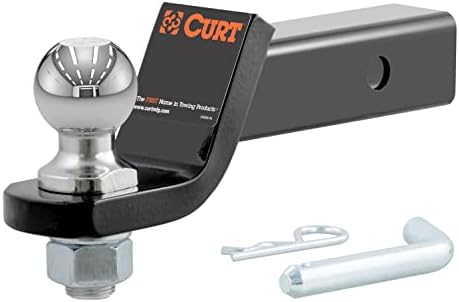
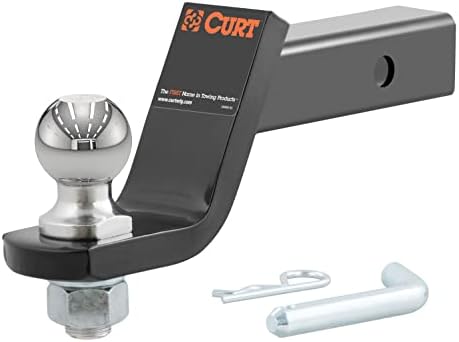
Your tow vehicle’s hitch class determines the maximum trailer and cargo weight you can safely pull. Using a hitch rated below the combined weight of the trailer and the loaded cart is a safety and legal violation in most states. The table below shows the four most common hitch classes with their standard ratings.
| Hitch Class | Max Towing Capacity | Max Tongue Weight | Common Vehicles |
|---|---|---|---|
| Class I (1-1/4 in. receiver) | 1,000-2,000 lbs | 200 lbs | Small cars, Honda HRV, Toyota Corolla |
| Class II (1-1/4 in. receiver) | 2,000-3,500 lbs | 350 lbs | Midsize cars, Honda CRV, Toyota RAV4 |
| Class III (2 in. receiver) | 3,500-8,000 lbs | 500-800 lbs | Full-size SUVs, pickup trucks |
| Class IV (2 in. receiver) | 5,000-10,000 lbs | 1,000+ lbs | Heavy-duty trucks, large SUVs |
To calculate your towing requirement: add the trailer’s dry weight to the cart’s curb weight. This is the minimum towing capacity your hitch and vehicle must support. Add 10 to 15 percent as a safety margin. For a 500 lb open utility trailer carrying a 970 lb EZGO TXT Electric, the combined weight is 1,470 lbs.
A Class I hitch rated at 1,500 lbs covers this with almost no margin. A Class II hitch at 3,500 lbs covers it with substantial margin. Always use the vehicle manufacturer’s stated towing capacity for your specific vehicle, not the hitch class rating alone. Many vehicles with Class II hitches installed are rated well below the hitch class maximum.
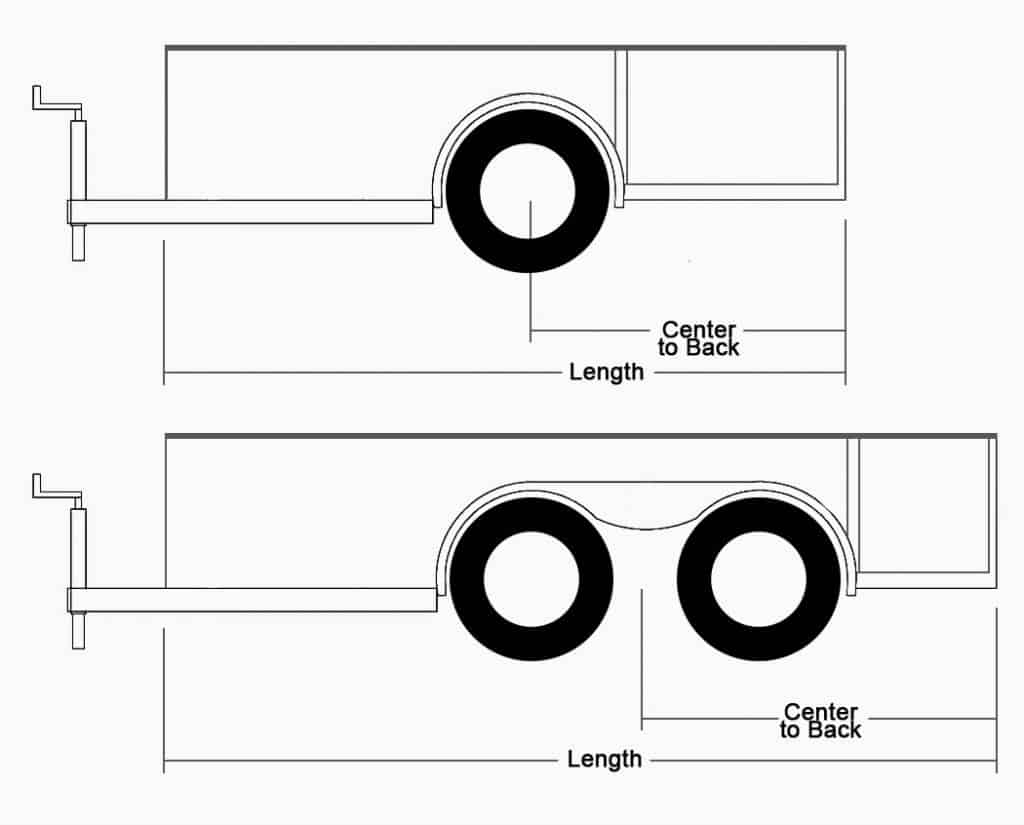
Tongue weight is the downward force the trailer exerts on the hitch ball. It should be 10 to 15 percent of the total loaded trailer weight. For a 1,470 lb combined weight, tongue weight should be 147 to 220 lbs. You can calculate tongue weight for your specific trailer using the Double D Trailers tongue weight calculator, which requires the trailer length, axle position, and load weight.
Golf Cart Trailer GVWR and Payload Capacity
GVWR stands for Gross Vehicle Weight Rating. It is the maximum total weight the trailer is rated to carry, including the trailer’s own weight. Not all manufacturers define GVWR the same way, which causes confusion when comparing trailers.
Some manufacturers rate GVWR as the maximum total weight at the axle, which includes the trailer’s own weight. Others rate it as the payload capacity only. To determine how much cargo a trailer can actually carry, use this formula: GVWR minus trailer dry weight equals payload capacity. A trailer with a 3,500 lb GVWR and a 700 lb dry weight has a 2,800 lb payload capacity. A trailer with a 2,000 lb GVWR and a 600 lb dry weight has a 1,400 lb payload capacity. Always confirm the dry weight of the trailer before calculating payload.
If a trailer has two axles, the GVWR is typically the sum of both axle ratings. Two 2,000 lb axles give a 4,000 lb GVWR. Single-axle trailers in the 3,500 lb GVWR range are adequate for most standard two-seat golf carts. Four-seat and six-seat carts approaching 1,500 lbs curb weight on a trailer with a 700 lb dry weight require a 3,500 lb GVWR minimum with no margin. A dual-axle trailer rated at 5,000 to 7,000 lb GVWR is the right choice for heavy carts, extended transport, and hilly terrain where trailer stability matters more.
Golf Cart Trailer Tie-Down Requirements
Tie-down straps are a legal requirement under NHTSA federal cargo securement regulations and a practical safety requirement regardless of legal status. A golf cart that shifts on a trailer during hard braking or a sharp turn can overturn the trailer or come loose entirely.
The minimum requirement for a cargo load is tie-downs with a combined working load limit of at least 50 percent of the cargo weight. For a 970 lb cart, you need tie-downs with a combined working load limit of at least 485 lbs. Four 1-inch ratchet straps with a 500 lb working load limit each give a combined 2,000 lb working load limit, well above the requirement and the practical standard for golf cart transport.
Use four tie-down points, two at the front axle area and two at the rear. Attach to the cart’s frame, not to the body panels, steering components, or suspension arms. On EZGO TXT and Club Car DS models, the front frame rail is the correct attachment point. On Yamaha Drive models, the front bumper frame mount is a solid point. Do not attach to the bumper plastic itself.
After driving the cart onto the trailer and before securing, center the cart on the deck side-to-side. An off-center load affects trailer tongue weight and towing stability. For a full guide on keeping your cart in the best condition for transport, see our golf cart maintenance checklist.
Four-pack with 1-inch straps and J-hooks for standard golf cart frame attachment. Use all four for secure four-point tie-down on any utility trailer.
View on Amazon →
Golf Cart Trailer Safety: Lighting, Brakes, and Registration
Every trailer towed on a public road requires functioning tail lights, brake lights, and turn signals. This is a federal requirement under FMCSA regulations and is enforced at the state level. A trailer without functioning lighting is an immediate traffic stop and ticket in every state. Most utility trailers come with a wiring harness that connects to a standard 4-pin or 7-pin plug on the tow vehicle.
Confirm your tow vehicle has the correct connector before buying a trailer, and test all lights before the first trip. If you are also planning to make the cart itself street legal for on-road use, see our guide on how to make a golf cart street legal for the full lighting and equipment requirements by state.
Electric brakes are required on trailers over a certain gross weight in most states, typically 3,000 lbs GVWR or higher, though this varies by state. If you are towing a heavy six-seat cart on a dual-axle trailer with a combined weight over 3,000 lbs, confirm your state’s brake requirement before buying a trailer without brakes. Towing an overweight trailer without brakes in a state that requires them is both dangerous and carries significant fines.
Trailer registration requirements also vary by state. Most states require registration for trailers over a certain weight, typically 1,500 to 3,000 lbs GVWR. Light utility trailers under the threshold may be exempt. Contact your state’s DMV to confirm before putting a new trailer on the road. Many states also require a trailer to display its own license plate.

Golf Cart Weight Table: Top 40 Models from EZGO, Club Car, and Yamaha
Use this table to find your cart’s curb weight before calculating your trailer and tow vehicle requirements. Curb weight is the manufacturer-published weight with all fluids and batteries installed. Dry weight is without batteries. Electric carts with lead-acid batteries are significantly heavier than gas carts of the same size. Lithium-equipped carts are closer to gas cart weight due to the lower battery weight. Use curb weight for all towing calculations.
| Manufacturer | Model | Length x Width | Curb Weight | Dry Weight |
|---|---|---|---|---|
| EZGO | ||||
| Freedom RXV Gas | 93.5 x 47 in. | 747 lbs | 697 lbs | |
| Freedom RXV Electric | 93.5 x 47 in. | 970 lbs | 642 lbs | |
| Freedom RXV ELiTE | 93.5 x 47 in. | 774 lbs | 674 lbs | |
| Freedom RXV 2+2 Gas | 105.5 x 47 in. | 825 lbs | 785 lbs | |
| Freedom RXV 2+2 Electric | 105.5 x 47 in. | 1,002 lbs | 674 lbs | |
| Freedom RXV 2+2 ELiTE | 105.5 x 47 in. | 859 lbs | 759 lbs | |
| Freedom TXT Gas | 93 x 47 in. | 750 lbs | 706 lbs | |
| Freedom TXT Electric | 93 x 47 in. | 972 lbs | 606 lbs | |
| Freedom TXT ELiTE | 93 x 47 in. | 638 lbs | 588 lbs | |
| Freedom TXT 2+2 Gas | 106 x 47 in. | 896 lbs | 861 lbs | |
| Freedom TXT 2+2 Electric | 106 x 47 in. | 1,036 lbs | 658 lbs | |
| Freedom TXT 2+2 ELiTE | 106 x 47 in. | 859 lbs | 759 lbs | |
| 72-Volt Freedom | 93.5 x 47 in. | 1,200 lbs | 573 lbs | |
| Express S4 Gas | 114 x 48.5 in. | 984 lbs | 937 lbs | |
| Express S4 Electric | 114 x 48.5 in. | 1,210 lbs | 844 lbs | |
| Express S4 High Output | 114 x 48.5 in. | 1,210 lbs | 844 lbs | |
| Express S6 Gas | 141.5 x 48.5 in. | 1,039 lbs | 992 lbs | |
| Express S6 Electric | 135.8 x 49 in. | 1,456 lbs | 964 lbs | |
| Express L6 Gas | 143.5 x 49 in. | 1,110 lbs | 1,063 lbs | |
| Express L6 Electric | 143.5 x 49 in. | 1,560 lbs | 964 lbs | |
| 2Five Electric | 107.1 x 47.3 in. | 1,200 lbs | 872 lbs | |
| Valor | 93.5 x 47 in. | 816 lbs | 776 lbs | |
| Club Car | ||||
| Onward Lifted 4 Passenger Electric | 114 x 49.5 in. | 1,125 lbs | ||
| Onward Lifted 4 Passenger Gas | 114 x 49.5 in. | 875 lbs | ||
| Onward 4 Passenger Electric | 108 x 48.75 in. | 1,070 lbs | ||
| Onward 4 Passenger Gas | 108 x 48.75 in. | 795 lbs | ||
| Onward 2 Passenger Electric | 92 x 48.75 in. | 975 lbs | ||
| Onward 2 Passenger Gas | 92 x 48.75 in. | 675 lbs | ||
| Precedent Stretch PTV | 144 x 47.25 in. | 1,176 lbs | ||
| Villager 2 Electric | 92 x 47 in. | 909 lbs | ||
| Villager 2 Gas | 92 x 47 in. | 651 lbs | ||
| Yamaha | ||||
| Drive 2 Fleet | 93.6 x 47.3 in. | 720 lbs | ||
| Drive 2 PTV | 93.6 x 47.3 in. | 720 lbs | ||
| Concierge 4 | 128 x 47.2 in. | 767 lbs | ||
| Concierge 6 | 161.4 x 47.2 in. | 1,010 lbs | ||
| Adventurer Sport | 107.3 x 51 in. | 823 lbs | ||
| Adventurer Sport 2+2 Gas | 108.9 x 50.9 in. | 905 lbs | ||
| Adventurer Sport 2+2 Electric | 108.9 x 50.9 in. | 788 lbs | ||
| Umax One | 111.45 x 49.33 in. | 930 lbs | ||
| Umax Two | 119.37 x 49.33 in. | 1,003 lbs | ||
Golf Cart Trailer Price Tiers: What You Get at Each Level
Golf cart trailer prices in 2026 fall into three tiers based on construction, features, and material quality. Knowing what each tier delivers helps you avoid overpaying for features you do not need and underpaying into a trailer that will not last.
Budget tier ($600 to $1,200) covers basic single-axle open steel utility trailers with manual fold-down ramps and basic lighting. These trailers are adequate for occasional local transport of a standard two-seat cart. Quality control varies significantly at this price point, check welds, floor thickness, and hitch hardware before buying. Galvanized or powder-coated finishes improve longevity significantly over bare steel. Avoid bare steel trailers in wet climates.
Mid-range tier ($1,200 to $2,800) covers better-quality steel trailers, entry-level aluminum trailers, tilt-bed configurations, and single-axle trailers with electric brakes. This is the best value tier for regular users. Aluminum trailers in this range will outlast steel trailers by a significant margin with minimal maintenance. Tilt-bed trailers in this range solve the ramp angle problem and are worth the premium for owners with stock-clearance carts.
Premium tier ($2,800 and above) covers high-quality aluminum utility trailers with dual axles, enclosed trailers, and custom configurations for four and six-seat carts. The Aluma 7816ESA-TA is a commonly referenced high-quality aluminum utility trailer in this range with a 5,950 lb payload capacity and a bi-fold tailgate. For fleet operators or owners transporting heavy carts regularly over long distances, the premium tier is worth the investment. For the owner who moves the cart six times a year to a local course, the mid-range tier delivers better value.


Frequently Asked Questions About Golf Cart Trailers
What size trailer do I need for a golf cart?
For a standard two-seat golf cart, a 5×10 open utility trailer covers most configurations. Measure your cart’s width at its widest point (including mirrors if fitted) and confirm the trailer deck is at least 6 inches wider on each side. For four-seat carts, use a 6×12 minimum. For six-seat carts over 135 inches long, a 6×14 or 7×14 trailer is required. Always measure the cart before buying the trailer, do not rely on generic recommendations.
Will a golf cart fit on a 4×8 trailer?
No. A standard golf cart is 47 to 49 inches wide and 92 to 94 inches long. A 4×8 trailer has a 48-inch wide deck and a 96-inch deck, the cart width alone leaves almost no clearance and the length is marginal. A 5×10 is the practical minimum for any standard two-seat cart. A 4×8 is too narrow for safe loading and too short for proper tie-down positioning.
Do I need brakes on a golf cart trailer?
It depends on the trailer’s GVWR and your state’s regulations. Most states require trailer brakes when the trailer GVWR exceeds 1,500 to 3,000 lbs depending on the state. If your trailer and loaded cart combined exceed 3,000 lbs, assume brakes are required in most jurisdictions. Contact your state’s DMV to confirm the exact threshold before buying a trailer without brakes. Trailers with electric brakes are the standard for heavier configurations and are worth specifying even where not legally required for the improved stopping performance.
Is aluminum or steel better for a golf cart trailer?
Aluminum is better for longevity with minimal maintenance. Steel is cheaper upfront. A galvanized or powder-coated steel trailer stored in a dry climate will last 10 to 15 years with occasional maintenance. The same trailer stored outdoors in a wet climate will show rust at the welds within 5 years without painting. An aluminum trailer costs 25 to 40 percent more than equivalent steel but requires no corrosion maintenance, weighs less (more payload available for the cart), and will outlast most steel trailers in any climate. For regular users, the total cost of ownership over 15 years typically favors aluminum.
How do I calculate tongue weight for my golf cart trailer?
Tongue weight should be 10 to 15 percent of the total loaded trailer weight. For a 1,500 lb combined trailer and cart weight, target 150 to 225 lbs of tongue weight. Position the cart slightly forward of center on the trailer deck to achieve the correct tongue weight distribution. An off-center forward load increases tongue weight; an off-center rearward load reduces it and can cause trailer sway. The Double D Trailers calculator linked in the tongue weight section of this article calculates tongue weight precisely based on your trailer’s axle position and load placement.
About the Author
Chuck Wilson spent decades as a golf cart and small vehicle mechanic before retiring. His shop work covered Club Car, EZGO, and Yamaha platforms across gas and electric drivetrains. He runs GolfCartTips.com in retirement, writing about repairs and maintenance based on jobs he has actually done, not manufacturer talking points. If a procedure is on this site, it has been performed on a real cart.
Last verified on: EZGO, Club Car, and Yamaha published specifications May 2026. Hitch class ratings sourced from SAE J684 standard. NHTSA cargo securement requirements sourced from 49 CFR Part 393.