How Long Do Golf Cart Batteries Last? 5 Factors That Decide
How long do golf cart batteries last depends on chemistry first, habits second. Flooded lead-acid packs typically run 4 to 6 years. AGM batteries stretch to 5 to 7 years. Lithium (LiFePO4) packs hit 10 to 15 years with a proper charger. Every one of those ranges can be cut in half by five specific mistakes. Every one of them is avoidable.
Last verified: Club Car DS 48V (6×8V flooded), EZGO TXT 36V (6×6V flooded), Yamaha Drive 48V (6×8V flooded) | June 2026 | Trojan T-875, US Battery US8VGCHC XC2, Dakota Lithium 48V 60Ah
Key Takeaways
- Most owners replace flooded lead-acid packs every 4 to 6 years, but packs that never get watered or sit discharged for weeks can fail in under 3 years. The chemistry is not the limiting factor. The maintenance record is.
- Never mix battery ages or brands within a pack. One weak cell drags the entire string down. When one battery in a 6-battery pack goes bad, replace all six. Replacing a single bad battery into an aged pack wastes money and accelerates the failure of everything else in the string.
- Lithium conversions require a lithium-specific charger profile. A lead-acid charger running a lithium pack will undercharge it, leaving 20 to 30 percent of capacity unused every cycle and degrading the cells over time. This is the single most common mistake on lithium conversions.
Golf Cart Battery Lifespan by Type
Battery type determines the upper limit on lifespan. Maintenance and usage determine whether you get anywhere near it. Here is what to expect from each chemistry in a real-world golf cart application:

| Battery Type | Typical Lifespan | Cycle Count | Maintenance | Relative Cost |
|---|---|---|---|---|
| Flooded Lead-Acid | 4–6 years | 500–800 | Water every 4–8 weeks; equalize every 60–90 days | Lowest |
| AGM Lead-Acid | 5–7 years | 600–1,000 | Sealed: no watering; verify charger algorithm | Moderate |
| Gel Lead-Acid | 5–7 years | 500–800 | Sealed: low maintenance; very sensitive to overcharge | Moderate–High |
| Lithium (LiFePO4) | 10–15 years | 2,000–5,000 | None: BMS handles protection; lithium charger required | Highest upfront |
Flooded Lead-Acid
Flooded lead-acid is what comes stock in most Club Car DS, EZGO TXT, and Yamaha Drive carts. A well-maintained pack runs 4 to 6 years and 500 to 800 full discharge cycles. These batteries need to be watered every 4 to 8 weeks during active use, more often in summer heat. Use distilled water only. Tap water contains minerals that contaminate the electrolyte and accelerate plate sulfation. Fill to just above the plates, never above the fill ring. Electrolyte that overflows during charging damages terminals and the battery tray.
Flooded batteries also need equalization every 60 to 90 days: a controlled overcharge at roughly 10 percent above the normal charge voltage that drives stratified acid back into suspension and breaks up light sulfation on the plates. Skip equalization consistently and expect to lose a full year off the pack’s life.

- Trojan T-875 Deep-Cycle Flooded/Wet Lead-Acid Battery
- This is the 170Ah, 8-volt deep cycle battery from Trojan, in the popular “Golf Car” (GC8) size. These can be used in RV’…
- BCI Group Size: GC8 – Dimensions: Length: 10.27” (261mm); Width: 7.10” (180mm); Height: 11.14” (283mm)
AGM Lead-Acid
AGM (absorbed glass mat) batteries seal the electrolyte in fiberglass mats. No watering, no equalization, no acid spill risk. They handle vibration better than flooded cells and work well in tilted or rough-terrain applications. Lifespan runs 5 to 7 years and 600 to 1,000 cycles under normal use. The tradeoff is cost: AGM packs run 40 to 60 percent more than comparable flooded batteries up front. They are also more sensitive to overcharging. If your charger’s bulk voltage is set for flooded cells (typically 7.4 to 7.5 volts per 6V cell on a 36V or 48V system), it may be running too high for AGM. Check the charger algorithm before swapping chemistry.
Gel Lead-Acid
Gel batteries suspend the electrolyte in silica gel rather than liquid. That makes them spill-proof and tolerant of storage in any orientation. Lifespan is similar to AGM: 5 to 7 years under normal use. The significant downside is sensitivity to overcharging. Gel cells require a lower bulk voltage than flooded or AGM batteries, typically no higher than 7.2 volts per 6V cell. A standard flooded charger will overcharge a gel pack and damage the gel matrix permanently. Gel batteries are uncommon in stock golf cart configurations but occasionally show up in aftermarket replacements. If you are unsure what chemistry is in your pack, check the case label before connecting a charger.
Lithium (LiFePO4)
LiFePO4 lithium packs run 10 to 15 years and 2,000 to 5,000 cycles. The longer cycle life makes the higher upfront cost reasonable over time, especially for daily-use carts. Lithium cells do not sulfate, do not need watering, and do not lose capacity through self-discharge the way lead-acid cells do. The built-in Battery Management System (BMS) handles overcharge, over-discharge, and temperature protection.
What lithium does require is a charger profile matched to lithium chemistry. A standard lead-acid charger will read the lithium pack as “full” before it actually is, cutting off the charge cycle 20 to 30 percent early. Over time, that shortfall compounds. Always specify a lithium-compatible charger when converting. Note also that some “48V” lithium packs run at 51.2V nominal (16 cells at 3.2V). Verify the actual pack voltage before selecting a charger or controller.
The 5 Factors That Determine How Long Golf Cart Batteries Last
Two identical packs bought the same week can end up with a two-year difference in lifespan depending on how they are used. These are the five variables that matter most.
Depth of Discharge
Flooded lead-acid batteries should not be regularly discharged below 50 percent state of charge. On a 48V pack, that is roughly 47 to 48 volts resting voltage after a 30-minute rest off the charger. Consistent deep discharges below that threshold accelerate plate sulfation and reduce the number of cycles the battery will accept before capacity drops significantly. LiFePO4 batteries tolerate deeper discharge (down to 20 percent) without the same damage, which is one of the practical reasons their cycle count is so much higher.
For golf cart owners with a lead-acid pack: if the cart feels sluggish or the voltage gauge reads low mid-round, you are already in the damage zone. Charge it before the next use, not after it fully recovers on its own.
Charging Habits
Charge the cart after every use, not just when it feels slow. Lead-acid batteries that sit partially discharged develop sulfate crystals on the plates (sulfation) that reduce capacity permanently. On a modern automatic charger, plug the cart in as soon as you park it and let the charger complete its cycle. Do not interrupt the charge cycle midway. Do not use a charger rated for a different system voltage than your pack. A 36V charger on a 48V pack will not fully charge the batteries and may confuse the charger’s shutoff logic. Match charger voltage to pack voltage exactly.
For storage periods longer than three weeks, either leave the cart connected to a smart charger with a maintenance mode or check pack voltage monthly and top up if it has dropped more than two volts below full charge.
Water and Electrolyte Maintenance (Flooded Only)
Watering is the single maintenance task most owners neglect, and it is the one that kills more flooded packs than any other. Check the water level once a month during the riding season. After a full charge, the electrolyte level should be at or just below the bottom of the fill ring, about a quarter inch above the top of the plates. Add distilled water to bring it to that level. Do not add water to a discharged battery. The electrolyte expands during charging and will overflow.
Do not use tap water under any circumstances. The mineral content in tap water, including calcium, magnesium, and chlorine, reacts with the electrolyte and deposits sediment on the plates. One filling with tap water will not destroy the battery, but repeated fillings over months will noticeably reduce cell capacity. A single-point watering kit makes the job faster and eliminates the risk of overfilling individual cells. Worth adding to any cart you plan to keep for more than two years.
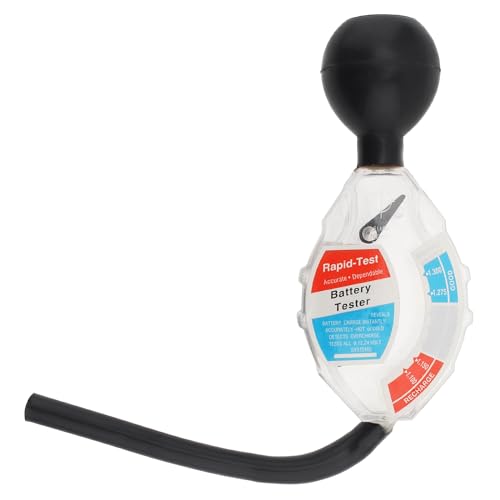
- This deep cycle battery hydrometer tester works on all 6-12-24 volt systems. With a range of 1. 100 – 1. 300, You can co…
- Whether the battery is hot or cold, the hydrometer can immediately and accurately delivers accurate readings, ensuring y…
- The golf car battery hydrometer is made of high-quality plastic, not easy to break, durable, and can be used for a long …

- Designed for 2018 or Older Club Car Precedent – Custom-fit for golf carts using six 8V batteries.
- Single-Point Watering System – Quickly and efficiently fill all battery cells at once, saving time and effort.
- Improves Battery Life – Maintains proper electrolyte levels to extend battery longevity and optimize performance.
Pack Consistency
A golf cart battery pack is a series circuit. All the batteries in the string carry the same current, and the weakest cell in the pack sets the ceiling for everything else. If one battery in a 6-battery 48V pack has degraded capacity, the charger will attempt to bring that cell up to full voltage, which means the other five batteries in the string get overcharged in the process. Overcharging accelerates water loss in flooded cells and degrades AGM separators.
The right response when one battery tests significantly below the others is to replace the full pack, not just the weak unit. A single new battery spliced into a four-year-old string will not perform like a new battery. It will charge and discharge at the rate the aged batteries dictate, and the string will fail again within a year or two. Learn how to test your golf cart batteries with a load tester or hydrometer before deciding whether to replace one or all.
Storage Conditions
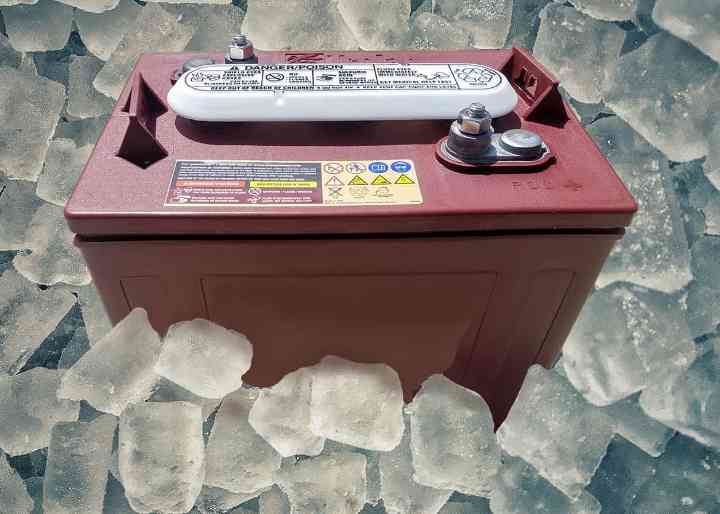
Heat kills lead-acid batteries faster than cold does. A flooded battery stored in a hot garage through a Southern summer loses water faster and builds up internal pressure that degrades the plates. Cold storage slows chemical reactions and reduces capacity temporarily but does not cause permanent damage unless the battery is discharged below about 50 percent and then freezes. A discharged flooded cell can freeze at temperatures as low as 20 degrees Fahrenheit. The lower the state of charge, the higher the freeze point.
Store the cart in the coolest area available, keep the batteries at full charge before storage, and check them monthly during the off-season. For detailed guidance on prepping a lead-acid pack for a long off-season, see winterizing your golf cart batteries.
Signs a Golf Cart Battery Pack Is Failing
A failing pack gives clear signals before it dies completely. Know what to look for so you are not surprised in the middle of a round or a long commute across the property.
- Reduced range: If the cart used to cover 18 holes comfortably and now struggles through 12, capacity has dropped. Lead-acid packs lose usable range gradually as cycle life accumulates.
- Slow acceleration and reduced top speed: Worn batteries cannot sustain the current draw a controller demands under load. The controller sees low voltage and limits output. On a Curtis or Club Car OBC-equipped cart, this often triggers a fault code before the pack fully dies.
- Charger that never finishes or finishes too quickly: If the charger runs for 10 hours and then clicks off but the cart barely makes it off the driveway, the pack is not accepting a full charge. If the charger shuts off after 30 minutes on a pack that should need 8 hours, the charger is reading falsely high voltage from a failed cell. The pack needs immediate testing.
- Visible damage: Swollen or bulging battery cases, acid crust on terminals or the tray floor, and cracked case seams all indicate a battery that is past its service life. Corrosion on terminals also increases resistance in the circuit, which reduces performance and can generate heat.
- Hydrometer readings out of range: On a flooded battery, specific gravity should read 1.265 to 1.280 when fully charged. A reading below 1.230 on a charged battery indicates a tired or sulfated cell. A cell more than 0.050 points below the others in the pack is the weak link that is dragging the string down.
How Far Will Golf Cart Batteries Last on One Charge?
Range per charge is a separate question from pack lifespan, but the two are connected. A pack that delivers full range is a healthy pack. A pack that falls short of its rated range is either aged, undercharged, or carrying a weak cell. Here are realistic mileage figures by battery type under normal two-passenger, flat-terrain conditions.
| Battery Type | Pack Config (48V) | Range Per Charge | Drive Time (moderate use) |
|---|---|---|---|
| Flooded Lead-Acid (new) | 6×8V or 8×6V | 18–25 miles | 4–6 hours |
| Flooded Lead-Acid (3–4 yrs) | 6×8V or 8×6V | 12–18 miles | 3–4 hours |
| AGM Lead-Acid (new) | 6×8V or 8×6V | 20–28 miles | 5–7 hours |
| Lithium LiFePO4 (new) | Single 48V unit | 25–40 miles | 6–8 hours |
Three variables cut into those numbers faster than anything else. Terrain is the biggest one: a hilly course or property with significant grade changes can cut range by 30 to 40 percent compared to flat ground. Load is second: add two passengers and a full cargo bed to a two-passenger cart spec and the motor draws more current on every incline. Tire pressure is third and the most commonly ignored: underinflated tires increase rolling resistance and shorten range.
A new pack that is not delivering rated range is usually a tire or loading issue, not a battery issue. An aged pack that falls below the “3–4 yr” row in the table above is telling you the cells have lost capacity and testing is overdue.
Lithium packs maintain voltage more consistently under load than lead-acid throughout the discharge cycle. A flooded lead-acid pack loses voltage progressively as it discharges, which means the controller throttles output earlier in the discharge. A lithium pack holds near-nominal voltage until it approaches the BMS low-cutoff, delivering more usable power per charge. That is why a lithium pack with the same nominal amp-hour rating covers more miles than a flooded pack on the same cart.
Battery Lifespan by Golf Cart Platform
The platform matters because charger algorithms, pack voltage, and battery configuration differ between Club Car, EZGO, and Yamaha. A Powerwise charger on an EZGO TXT uses a different charge algorithm than a Club Car PowerDrive or a Yamaha OBC-equipped unit. Using an off-brand charger that does not match the OEM algorithm can leave the pack chronically undercharged or overcharged, cutting years off the service life.
| Platform | Pack Voltage | Battery Config | OEM Charger | Algorithm Type |
|---|---|---|---|---|
| Club Car DS | 48V | 6×8V | PowerDrive 3 | Delta-voltage shutoff |
| Club Car Precedent | 48V | 6×8V | PowerDrive 3 | Delta-voltage shutoff |
| EZGO TXT (36V) | 36V | 6×6V | Powerwise 36V | Two-phase |
| EZGO TXT (48V) | 48V | 6×8V | Powerwise 48V | Two-phase |
| Yamaha Drive / Drive2 | 48V | 6×8V | Yamaha OBC charger | OBC-controlled |
For lithium conversions on any of these platforms, the OEM charger must be replaced or reprogrammed. A delta-voltage shutoff charger (Club Car) will cut off a lithium pack before it reaches full charge. A two-phase Powerwise charger (EZGO) has the same problem. Most lithium pack suppliers offer a drop-in charger matched to their BMS profile. Buy it at the same time as the pack, not after the fact.
Club Car DS and Precedent (48V): Stock configuration runs six 8V batteries in series. The PowerDrive charger uses a delta-voltage shutoff that works well with flooded cells but needs a lithium algorithm profile for LiFePO4 conversions. Club Car DS and Precedent have different controller pinouts. Do not cross-reference battery or charger specs between the two without confirming the year and model.
EZGO TXT (36V or 48V): Older TXT models run six 6V batteries (36V); 48V upgrades run six 8V batteries. The Powerwise charger uses a two-phase charge cycle. EZGO’s stock D-style plug is proprietary. Aftermarket chargers need a matching connector or adapter. On electric TXT models, the series-wound motor draws higher current under load than a Club Car’s shunt-wound motor, which means pack voltage sag is more pronounced at the end of charge. Test the pack under load, not just at rest.
Yamaha Drive and Drive2 (48V): Both run six 8V batteries. The Drive and Drive2 use different forward/reverse switch wiring between generations. Confirm the year before swapping components. Yamaha’s OBC (onboard computer) monitors battery voltage and can restrict performance when it detects low pack voltage. If the cart enters limp mode prematurely, check the OBC fault history before condemning the pack. A loose connection or a faulty voltage sensor can mimic a dead battery reading.
FAQ
How long do golf cart batteries last on a single charge?
A healthy 48V flooded lead-acid pack in a standard two-passenger cart covers 18 to 25 miles per charge on flat terrain, or about 4 to 6 hours of moderate use. A lithium pack of equivalent voltage and amp-hour rating covers more ground per charge (typically 25 to 40 miles) because lithium maintains voltage more consistently under load. Hills, added passengers, cargo weight, and tire pressure all affect range. If a pack that used to cover 18 holes comfortably now runs out on hole 13, battery capacity has dropped and the pack needs testing.
Can I replace just one bad battery in my golf cart pack?
Replacing a single battery in an aged pack is almost always a waste of money. The new battery will charge and discharge at the rate set by the older cells in the string, and the imbalance accelerates wear on the new unit. If one battery tests significantly below the rest of the pack, replace all of them. If the pack is less than a year old and one cell has a manufacturing defect, replacing just that unit with the same brand and model is acceptable. Verify the other cells test within 0.020 specific gravity points of each other before assuming the rest of the pack is healthy.
How do I know when my golf cart batteries need to be replaced?
Test the pack under load, not just at rest. A battery hydrometer reading below 1.230 specific gravity on a fully charged flooded cell indicates a worn or sulfated cell. A digital voltmeter across each battery at rest after a full charge should read within 0.3 volts of the others in the pack. Any cell reading more than 0.5 volts below the rest is the weak link. If the cart’s range has dropped more than 20 percent from when the pack was new, and the batteries are over three years old, budget for a replacement pack rather than continuing to chase symptoms.
Does storing a golf cart in the cold shorten battery life?
Cold slows the chemical reactions inside a lead-acid battery and temporarily reduces available capacity, but it does not cause permanent damage on its own. The risk is a discharged battery freezing. A fully charged flooded battery does not freeze until around minus 75 degrees Fahrenheit. Cold storage is not a problem if the pack is kept at full charge. A discharged cell can freeze at 20 degrees Fahrenheit. Freezing cracks the plates and destroys the battery. Before putting the cart away for winter, bring the pack to a full charge and check it every 4 to 6 weeks.
Is it worth upgrading to lithium batteries?
It depends on how long you plan to keep the cart and how much the cart is used. The upfront cost difference is real, but spread across the service life, lithium often wins on daily-use carts.
| Battery Type | Pack Cost (48V) | Typical Lifespan | Charger Needed | Approx. Cost/Year |
|---|---|---|---|---|
| Flooded Lead-Acid | $800–$1,200 | 4–6 years | OEM lead-acid | $150–$250 |
| AGM Lead-Acid | $1,200–$1,800 | 5–7 years | AGM-algorithm charger | $175–$300 |
| Lithium (LiFePO4) | $2,000–$2,800 + charger | 10–15 years | Lithium-profile charger | $160–$260 |
The charger is not optional. A lithium conversion requires a lithium-profile charger. Budget $150 to $400 for the charger as part of the conversion cost. For a cart used twice a month on weekends, the math shifts back toward lead-acid. The pack simply does not cycle enough to realize the lithium lifespan advantage. For a daily-use cart, community or campus cart, or any cart that charges and discharges five or more times per week, lithium cost-per-year lands in the same range as flooded lead-acid with far less maintenance time.
- Trojan T-875 Deep-Cycle Flooded/Wet Lead-Acid Battery
- This is the 170Ah, 8-volt deep cycle battery from Trojan, in the popular “Golf Car” (GC8) size. These can be used in RV’…
- BCI Group Size: GC8 – Dimensions: Length: 10.27” (261mm); Width: 7.10” (180mm); Height: 11.14” (283mm)
References
- Trojan Battery Company — Battery Maintenance Guide (trojanbattery.com)
- Trojan Battery Company — How to Maintain Your Flooded Lead Acid Battery (trojanbattery.com)
- Club Car DS Service Manual — Battery System section (2020 edition)
- EZGO TXT Service and Repair Manual — Electrical System chapter (2019 edition)
- Yamaha Drive2 Service Manual — Power Supply / Battery section (2018 edition)
About the Author
Chuck Wilson spent decades as a golf cart and small vehicle mechanic before retiring. His shop work covered Club Car, EZGO, and Yamaha platforms across gas and electric drivetrains. He runs GolfCartTips.com in retirement, writing about repairs and maintenance based on jobs he has actually done, not manufacturer talking points. If a procedure is on this site, it has been performed on a real cart.
Last verified on: Club Car DS 48V (6×8V flooded Trojan T-875), EZGO TXT 36V (6×6V US Battery XC2), Yamaha Drive 48V (6×8V flooded). Hydrometer used: Sears Craftsman 3-ball float type, cross-checked against refractometer readings.