Trojan Golf Cart Batteries: 5 Proven Reasons Worth Buying
Trojan golf cart batteries have dominated the deep-cycle battery market for decades and for good reason. The T-605 6V and T-875 8V are the most widely specified flooded lead-acid batteries for golf cart applications across every major platform. They are not the cheapest option in the deep-cycle battery market, and they are not marketed as such.
What they are is consistent: consistent plate quality, consistent electrolyte formulation, consistent cycle life, and consistent availability through dealers and battery shops nationwide. This review covers what you actually get for the price, which Trojan models fit which carts, what the total cost of ownership looks like compared to budget alternatives, and when it makes sense to look elsewhere.
Last verified: Trojan T-605, T-875, T-1275, and T-1260 models | May 2026 | Flooded lead-acid unless noted. Trojan lithium models noted separately
Key Takeaways
- Trojan batteries cost more upfront than budget alternatives but the total cost of ownership over a 5-year period is typically lower. A budget pack that costs $400 and lasts 2 to 3 years with moderate maintenance costs $800 to $1,200 over 5 years in replacement and service costs. A Trojan pack that costs $650 and lasts 5 to 6 years with proper maintenance costs less per year over the same period. Run the 5-year numbers before deciding the Trojan price is too high.
- Trojan deep cycle batteries are available in popular types that cover every major golf cart platform: 6V (T-605), 8V (T-875, T-890), and 12V (T-1260, T-1275). Fitment depends on your cart’s system voltage and battery count. Confirm both before ordering. Mixing Trojan batteries with batteries from other brands or different production dates in the same pack shortens the lifespan of the entire string.
- Trojan’s deep-cycle battery technology relies on thick positive plates and a high-density active material formulation designed specifically for the repeated deep discharge and recharge cycles that golf cart use demands. This is what distinguishes a purpose-built deep-cycle battery from a starting battery or a dual-purpose battery, and it is why substituting a cheaper deep-cycle alternative with thinner plates produces shorter service life under the same usage conditions.
What Makes Trojan Golf Cart Batteries Different From Budget Alternatives
Trojan Battery Company has been manufacturing deep-cycle batteries since 1925. The deep-cycle battery market contains a wide range of products at different price points, and not all deep-cycle batteries are built to the same standard. The distinction that matters for golf cart use is plate thickness and active material density.
A golf cart deep-cycle battery experiences a fundamentally different discharge pattern than a car starting battery. A car battery delivers a large current burst for two seconds, then the alternator takes over and the battery floats near full charge for the rest of the drive. A golf cart battery discharges moderately but continuously for 45 minutes to several hours, then recharges fully, then repeats. That cycle profile is what deep-cycle batteries are designed for, but not all deep-cycle batteries are designed equally for it.
Trojan’s flooded lead-acid deep cycle batteries use thicker positive plates than most budget alternatives. Thicker plates hold more active material, which means more charge can be stored per cycle and the plates take longer to shed that material into the electrolyte through repeated cycling. Plate shedding is the primary cause of capacity loss in flooded lead-acid batteries over time.
A battery with thicker plates sheds more slowly, maintains capacity longer, and delivers more total energy over its service life than one with thinner plates, even if both are rated at the same nominal capacity when new. The Battery University guide to lead-acid battery chemistry covers plate degradation and active material loss in detail for those who want to understand the underlying mechanism.
Trojan also maintains tighter quality control on electrolyte specific gravity consistency across cells within a battery. Inconsistent electrolyte specific gravity between cells in a new battery is a common cause of premature pack failure. The weaker cell gets driven below its minimum voltage during discharge before the stronger cells are depleted, creating an imbalance that worsens with each cycle.
Trojan’s advanced battery technology and manufacturing consistency reduces this risk compared to budget brands with less rigorous production standards. As the leading brand in the deep-cycle battery market for golf cart applications, Trojan has built its reputation on this consistency over nearly a century of production.
Trojan Golf Cart Batteries: Popular Types and Which Cart They Fit
Trojan manufactures several popular types of batteries for golf cart use. The correct model depends on your cart’s system voltage and the number of batteries in the pack. Confirm both before ordering. The most commonly specified Trojan deep cycle batteries for golf cart applications are listed below with fitment notes.
The T-605 is a 6V flooded lead-acid battery rated at 210Ah at the 20-hour rate. It is the standard specification for 36V systems using six 6V batteries in series, and for 48V systems using eight 6V batteries in series. It is one of the most widely available deep-cycle batteries in the market and is stocked by most golf cart dealers and battery distributors nationwide. If you own a vintage EZGO or Club Car running a 36V six-battery system, the T-605 is the standard replacement.

- 6V Deep-Cycle Flooded Battery – The Trojan T-605 delivers reliable power and long runtimes for golf carts, renewable ene…
- Proven Lead-Acid Construction – Built with thick plates and Trojan’s Alpha Plus paste for strong discharge performance a…
- Durable Polypropylene Case – The maroon housing is impact-resistant and designed to withstand vibration and demanding us…
The T-875 is an 8V flooded lead-acid battery rated at 170Ah at the 20-hour rate. It is the standard specification for 48V systems using six 8V batteries in series, which is the most common configuration on EZGO TXT 48V, Club Car DS 48V, Club Car Precedent 48V, and Yamaha Drive 48V electric carts. If your 48V cart uses six batteries, it almost certainly uses 8V batteries and the T-875 is the standard Trojan replacement.
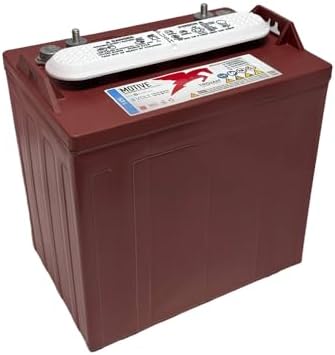
- 8V Deep-Cycle Flooded Battery – The Trojan T-875 delivers long runtime and consistent discharge performance for golf car…
- Flooded Lead-Acid Design – Built with Alpha Plus paste and thick lead plates for extended cycle life and deep discharge …
- Durable Polypropylene Case – The maroon housing is impact-resistant and designed to tolerate vibration and demanding use…
Standard 8V flooded lead-acid for 48V six-battery systems. Fits EZGO TXT, Club Car DS, Club Car Precedent, and Yamaha Drive 48V. Buy per cell: 6 per pack.
View on Amazon →
The T-890 is an 8V flooded lead-acid battery rated at 190Ah, higher capacity than the T-875 in the same footprint. It is a drop-in upgrade for any cart running T-875s where the tray dimensions allow it, delivering longer range per charge at the same system voltage. Verify tray dimensions before substituting T-890s for T-875s, as the T-890 is slightly taller than the T-875 on some production runs.
The T-1275 is a 12V flooded lead-acid battery rated at 150Ah. Some older Club Car DS models and certain four-battery 48V configurations use 12V batteries. Four T-1275s in series produce a 48V system. Verify your battery count and existing battery voltage before ordering.
Trojan also produces the Trojan Reliant AGM series and the Trojan TRAX lithium line for applications where sealed, maintenance-free operation is required. The AGM series suits owners who want the Trojan quality standard without the watering requirement. The lithium line is priced at a significant premium over the flooded models and competes with dedicated lithium drop-in suppliers. For most golf cart owners in the flooded lead-acid segment, the T-875 or T-605 remains the value benchmark in the deep-cycle battery market.
| Trojan Model | Voltage | Capacity (20hr) | Common Application | Battery Count |
|---|---|---|---|---|
| T-605 | 6V | 210Ah | 36V and 48V systems | 6 (36V) or 8 (48V) |
| T-875 | 8V | 170Ah | 48V EZGO, Club Car, Yamaha | 6 |
| T-890 | 8V | 190Ah | 48V upgrade over T-875 | 6 |
| T-1275 | 12V | 150Ah | 48V 4-battery systems | 4 |
| T-1260 | 12V | 130Ah | 36V 3-battery systems | 3 |
| Reliant AGM | 6V/8V/12V | Various | Sealed maintenance-free | Matches flooded config |
Trojan Golf Cart Batteries: Total Cost of Ownership vs Budget Alternatives
The upfront price difference between Trojan deep cycle batteries and budget alternatives is real. A set of six T-875s for a 48V cart runs $600 to $750 depending on supplier. A comparable set of budget 8V deep-cycle batteries runs $380 to $480. The $150 to $250 upfront difference is what most buyers see and react to.
The total cost calculation looks different when spread over the actual service life. Trojan T-875 batteries in a well-maintained pack on a cart used for regular golf rounds typically last 5 to 6 years. Budget 8V deep-cycle batteries from less established brands in the same application typically last 2.5 to 4 years with good maintenance, and 18 months to 2 years with average maintenance. The following comparison uses conservative figures for both options over a 6-year ownership window.
| Cost Factor | Trojan T-875 Pack | Budget 8V Pack |
|---|---|---|
| Initial pack cost | $700 | $430 |
| Expected lifespan | 5-6 years | 2.5-3.5 years |
| Replacements in 6 years | 1 | 2 |
| Total battery cost (6 yr) | $700 | $860 |
| Maintenance time saved | Baseline | More frequent watering and terminal work on budget cells |
| 6-year cost advantage | $160 lower |
These numbers assume proper maintenance on both packs. Neglected maintenance narrows the gap because a neglected Trojan pack also fails early. The Trojan advantage is most pronounced when both packs are maintained correctly, because the quality difference in plate thickness and active material density has the most room to express itself over a full service life under good conditions.
The advantage disappears if the cart is old, used infrequently, or likely to be replaced within two to three years. Putting a $700 Trojan pack into a 15-year-old cart that may not run for 5 more years is not a sound investment. In that scenario, a mid-tier brand at $480 makes more financial sense. Trojan is the right choice when the cart is in good condition, will be maintained properly, and will be in service for the full expected battery lifespan.
Trojan Golf Cart Batteries: Performance on Varied Terrain
The performance difference between Trojan deep cycle batteries and budget alternatives is most apparent on a variety of terrains and at partial states of charge. On a flat course at the beginning of a round, most deep-cycle batteries perform similarly. The differences emerge on hilly terrain, in the second half of a round, and on carts that are used multiple rounds per day.
Trojan’s thicker plate construction maintains voltage under load more consistently across a variety of terrains than thinner-plate budget alternatives. A cart climbing a steep incline places a high instantaneous current demand on the battery. A battery with thicker plates and more active material handles this current demand with less voltage sag. The cart maintains its speed on the incline rather than slowing noticeably as the motor draws more current than the battery can deliver without dropping voltage. On a flat course this difference is small. On a hilly course with multiple climbs per round, it is noticeable.
Fleet operators and golf course managers who run carts through multiple rounds per day on a variety of terrains consistently report the Trojan advantage in pack consistency across the operating day. A cart that runs its last round with the same performance as its first is worth more in a fleet context than one that performs well in the morning and struggles in the afternoon. Trojan batteries deliver this consistency more reliably than budget alternatives under fleet operating conditions.
Trojan Golf Cart Batteries Maintenance: What You Actually Need to Do
Trojan flooded lead-acid deep cycle batteries require the same maintenance as any flooded lead-acid battery, but Trojan provides clear guidance and a support line (800-423-6569) for maintenance questions during standard business hours. The maintenance requirements are not complicated and not time-consuming, but they are non-negotiable if you want the batteries to reach their rated service life.
Water levels in every cell should be checked monthly during the active golf season. Use distilled water only. Tap water contains minerals that contaminate the electrolyte and accelerate plate corrosion. Fill to just above the plates. Do not overfill.
Terminal cleaning should be performed at least twice a year using a baking soda solution, a wire brush, and terminal protector spray after reconnecting. The accessories and supplies needed are inexpensive and widely available: distilled water, a hydrometer, baking soda, a wire brush, and terminal protector spray cover every maintenance task.
Refills and terminal cleaning take under 30 minutes for a full pack and are the most important maintenance tasks for extending service life. Performing them consistently is also a matter of safety, as corroded or loose terminals generate heat under load that can damage cables and connectors over time.
Charge the pack fully after every use. Lead-acid batteries that sit in a partially discharged state sulfate progressively, and sulfation reduces capacity permanently over time. During storage, keep the pack on a float maintainer rated for your pack voltage. Check water levels before the first charge of the season and after the first few charge cycles, as the plates absorb water during the initial rehydration from winter storage.

Trojan publishes its own maintenance guide at trojanbattery.com with platform-specific watering intervals and charging recommendations. It is worth downloading and keeping with the cart. The guide also covers equalization charging , a periodic overcharge procedure that re-mixes stratified electrolyte and dissolves light sulfation buildup , which Trojan recommends every 30 to 60 days under normal use conditions.
If you want a read on actual battery condition beyond watering and visual inspection, see our guide on testing golf cart batteries , it covers hydrometer testing for specific gravity and load testing for capacity, both of which give you an objective measure of where each battery in the pack stands.
When Trojan Golf Cart Batteries Are Not the Right Choice
Trojan batteries are not the right choice in every situation. Understanding when to consider alternatives is part of making a sound purchasing decision rather than defaulting to the brand name.
If the cart is old and may not be in service for the full expected battery lifespan, a mid-tier brand at a lower price point delivers acceptable performance without the premium. The Trojan advantage compounds over 5 to 6 years. A cart that will be replaced in 2 years does not need a 6-year battery.
If you are planning a lithium conversion, flooded lead-acid batteries of any brand are a transitional purchase. Spending $700 on a Trojan pack before a planned lithium conversion 12 months later is wasteful. In that scenario, a budget pack that will last through the transition period is the more economical choice.
If maintenance will not be performed consistently, the Trojan advantage narrows significantly. A neglected Trojan pack lasts longer than a neglected budget pack but the premium is harder to justify if the maintenance that would extract the full value is not going to happen. If you cannot commit to monthly water checks during the season, an AGM battery, either the Trojan Reliant AGM or a quality sealed AGM from another manufacturer, is a better fit because it eliminates the watering requirement entirely.
For a full comparison of flooded lead-acid, AGM, and lithium options across different budgets and use cases, see our best golf cart battery guide.

Frequently Asked Questions About Trojan Golf Cart Batteries
Are Trojan golf cart batteries worth the money?
Yes, in most cases, when the cart will be in service for the full expected battery lifespan and maintenance will be performed consistently. The total cost of ownership over 5 to 6 years is typically lower than budget alternatives despite the higher upfront price, because Trojan batteries last longer and maintain capacity better through their service life. They are not worth the premium if the cart is near end of life, if maintenance will be inconsistent, or if a lithium conversion is planned in the near term.
Which Trojan battery fits my golf cart?
The correct Trojan model depends on your cart’s system voltage and battery count. Most 48V carts using six batteries need the T-875 (8V, 170Ah). Most 36V or 48V carts using six or eight 6V batteries need the T-605 (6V, 210Ah). Carts using four 12V batteries in a 48V system need the T-1275. Confirm your system voltage and battery count before ordering. Do not mix Trojan batteries with batteries from other brands in the same pack.
How long do Trojan golf cart batteries last?
Trojan flooded lead-acid deep cycle batteries in a well-maintained golf cart pack typically last 5 to 6 years. Packs that receive inconsistent maintenance or are regularly deep-discharged below 50 percent state of charge will fall short of that. Trojan AGM batteries last a similar period with less maintenance. Trojan’s TRAX lithium batteries are rated for significantly longer cycle life, comparable to other quality LiFePO4 products in the market.
What water should I use in Trojan golf cart batteries?
Distilled water only. Tap water contains minerals and chlorine that contaminate the electrolyte, accelerate plate corrosion, and shorten battery life. Distilled water is available at any grocery store for under $2 a gallon. Fill cells to just above the plates after charging, not before. Overfilling before a charge cycle forces electrolyte out of the cells as the battery gasses during charging.
Can I mix Trojan batteries with other brands in the same pack?
No. Mixing battery brands or mixing batteries from different production dates in the same series string creates an imbalanced pack where weaker batteries are driven below their minimum voltage during discharge before the stronger batteries are depleted. This accelerates degradation of the weaker batteries and drags the stronger ones down with them. Always replace the full pack at the same time using batteries from the same brand and ideally the same production run.
Where can I buy Trojan golf cart batteries?
Trojan batteries are available through golf cart dealers, battery specialty shops, and online retailers. Trojan’s website at trojanbattery.com has a dealer locator that finds authorized distributors near you. Buying through an authorized distributor ensures you are getting a battery from current production stock and not old inventory that has been sitting in a warehouse. Date codes on the battery case confirm production date , avoid any battery more than six months old from the production date.
About the Author
Chuck Wilson spent decades as a golf cart and small vehicle mechanic before retiring. His shop work covered Club Car, EZGO, and Yamaha platforms across gas and electric drivetrains. He runs GolfCartTips.com in retirement, writing about repairs and maintenance based on jobs he has actually done, not manufacturer talking points. If a procedure is on this site, it has been performed on a real cart.
Last verified on: EZGO TXT 48V, Club Car DS 48V, Yamaha Drive 48V. Trojan model specifications cross-referenced against Trojan Battery Company product documentation and dealer pricing as of May 2026.