48 Volt Golf Cart Charger Problems: What Each Fault Actually Means
A 48 volt golf cart charger that will not turn on, shuts off early, or charges slowly has one of a small number of causes. Most of them are not the charger itself. The battery pack voltage, the connector condition, the OBC circuit on modern platforms, and the charge port receptacle account for the majority of 48V charger faults. This guide works through the seven most common problems in diagnostic order, with the test procedures and voltage thresholds specific to 48V systems rather than the incorrect numbers that circulate online from 36V guides applied to 48V carts.
Last verified: EZGO TXT 48V, EZGO RXV 48V, Club Car DS 48V, Club Car Precedent 48V, Yamaha Drive 48V | May 2026 | OBC procedures are platform-specific, confirm your model before following OBC steps
Key Takeaways
- A 48V lead-acid pack reads approximately 50 to 52V at rest when fully charged. It should not drop below approximately 42V before the charger’s low-voltage cutoff triggers. A pack that reads below 42V at rest has either a dead cell, a severely discharged pack, or a failed battery. A pack reading 25 to 30V on a 48V system has a serious problem, the charger not turning on is the least of your concerns at that voltage level. Always use 48V-specific voltage thresholds, not thresholds copied from 36V guides.
- Modern EZGO RXV and Club Car Precedent models have an onboard computer (OBC) that controls the charging circuit. The OBC must detect the charger’s signal before it allows charging current to flow. A 48V charger plugged into one of these carts that does not start may be receiving a block signal from the OBC rather than indicating a charger fault. Testing the charger output voltage directly at the charger’s output terminals confirms whether the charger is functioning. If it outputs correct voltage, the OBC or the charge port wiring is the fault.
- Every major golf cart platform uses a different 48V charge connector. EZGO uses a D-style connector. Club Car uses a 3-pin round plug. Yamaha uses an SB-50 connector. Plugging the wrong charger into the wrong cart is physically prevented by connector shape on most platforms, but using an aftermarket charger with the wrong connector adapter can damage the charge port and the OBC. Always confirm the connector type matches the platform before connecting any replacement charger.
48 Volt Golf Cart Charger: Correct Voltage Thresholds
Before any 48 volt golf cart charger diagnosis, confirm you are using 48V-specific voltage thresholds. A significant amount of incorrect information circulates online with 36V thresholds applied to 48V systems. Using these wrong numbers leads to misdiagnosis.
A healthy 48V lead-acid pack (six 8V batteries or eight 6V batteries in series) reads approximately 50 to 52V at rest when fully charged. Under light load it reads approximately 48 to 50V. The charger’s auto-start circuit requires the pack to be above a minimum threshold, typically 40 to 42V on most charger models, before it will initiate a charge cycle. Below that threshold, the charger’s protection circuit prevents charging to avoid damaging a severely discharged or partially failed pack.
A pack reading below 40V at rest has either discharged below the safe level or has a failed battery. The correct remedy at that point is not to force the charger to start, it is to identify which battery has failed and address it. A pack at 35 to 38V has one significantly discharged or failed battery. A pack at 28 to 32V has multiple serious failures. At these voltages the charger not starting is doing its job correctly, not malfunctioning.
| Pack State | 48V Pack Resting Voltage | Charger Response |
|---|---|---|
| Fully charged | 50-52V | Charger may not start (already full) |
| Normal discharge, needs charge | 46-50V | Charger starts normally |
| Moderate discharge | 42-46V | Charger starts normally |
| Near low-voltage cutoff | 40-42V | Charger may start with delay |
| Below auto-start threshold | Below 40V | Charger will not auto-start, battery problem |
| Failed cell or severely discharged | Below 36V | Charger blocked, diagnose batteries first |
48 Volt Golf Cart Charger Fault 1: Charger Will Not Turn On
A 48 volt golf cart charger that does not turn on when plugged into the cart has one of four causes: the pack voltage is below the charger’s auto-start threshold, the charge port connector or receptacle has a fault, the OBC is blocking the charge signal on applicable platforms, or the charger itself has failed.
Test in this order. First, measure the pack voltage at the batteries with the charger disconnected. If the pack reads below 40V, the pack is the problem, see the battery recovery section below. If the pack reads above 40V, proceed to the next step.
Second, inspect the charge port receptacle on the cart. Look for bent pins, burned contacts, corrosion, or physical damage. A burned or corroded charge port prevents the charger from making a clean electrical connection. Clean corrosion with a small wire brush and dielectric grease on the contacts. Replace the receptacle if the pins are bent or burned.
Third, test the charger output voltage directly at the charger’s output terminals using a multimeter. With the charger plugged into the wall outlet but not connected to the cart, touch the multimeter probes to the charger’s output terminals. A functioning charger outputs voltage when not connected to a cart on most models, though some charger designs only output voltage when connected to a pack above the minimum threshold. Check the charger’s documentation for your specific model.
Fourth, if the pack voltage is adequate, the charge port is clean, and the charger outputs correct voltage when tested directly, the fault is in the OBC circuit on EZGO RXV and Club Car Precedent models. See Fault 5 below for the OBC diagnosis procedure.
48 Volt Golf Cart Charger Fault 2: Connector and Charge Port Issues
Connector compatibility is the most commonly overlooked aspect of 48 volt golf cart charger problems. Each major platform uses a different charge connector and the charger must match the cart’s receptacle.
EZGO TXT models use a D-style connector, which is an elongated plug with a D-shaped key that prevents incorrect orientation. EZGO RXV models use the same D-style connector on most years. Club Car DS and Precedent models use a 3-pin round plug with a specific pin spacing. Yamaha Drive models use an SB-50 connector, which is a large single-contact connector with a grey housing.
Using an aftermarket charger requires confirming the connector style matches the cart’s receptacle before purchasing. Many aftermarket 48V chargers are sold in multiple connector configurations, confirm the correct configuration for your platform at the time of purchase, not after the charger arrives.
Charge port receptacle wear is normal after years of use. The spring contacts inside the receptacle weaken over time and eventually fail to make reliable contact with the charger plug. A receptacle that charges the cart intermittently, working sometimes but not others with no change in pack voltage, usually has a worn receptacle rather than a faulty charger. Receptacle replacement is a straightforward job on most platforms and costs $20 to $50 for the part.
48 Volt Golf Cart Charger Fault 3: Charger Shuts Off Early
A 48 volt golf cart charger that starts normally but shuts off before the pack is fully charged is usually responding to a battery condition rather than failing. The charger’s algorithm monitors battery voltage and current during charging. When it detects a condition that suggests the pack is full or cannot accept more charge, it terminates the cycle.
Early shutoff is most commonly caused by a failed battery in the pack. When one battery in a series string fails internally and its voltage spikes above the correct per-battery level, the charger reads the overall pack voltage as high and terminates the cycle prematurely. The remaining batteries in the string are not fully charged but the charger has stopped because the failed battery’s voltage spike looks like a full charge.
To identify the failed battery, use a hydrometer to test specific gravity in each cell of every battery immediately after a charge cycle ends. A healthy fully-charged 8V lead-acid battery cell reads approximately 1.265 specific gravity. A cell reading below 1.200 in a pack where other cells read 1.265 has failed.
Alternatively, use a digital multimeter to measure the voltage of each individual battery immediately after the charger terminates. A battery reading significantly higher than the others has an internal short causing false high readings. See our guide on testing golf cart batteries for the full hydrometer and load test procedure.
48 Volt Golf Cart Charger Fault 4: Slow Charging
A 48 volt golf cart charger that is working but taking significantly longer than normal to complete a charge cycle is either facing a larger than normal charge demand or delivering less current than its rated output.
A larger charge demand occurs when the pack has been discharged more deeply than usual. A pack discharged to 42V takes longer to charge than one discharged to 46V, this is normal behavior, not a charger fault. If the extended charge time correlates with unusually deep discharges, the answer is shallower discharge cycles rather than charger diagnosis.
Reduced charger output occurs when the charger’s internal components are degraded. As chargers age, the output amperage gradually decreases. A charger rated at 15A that is now delivering 8A will charge the pack but at roughly half the normal rate. Test charger output amperage with a clamp meter on the output cable during charging. Compare the reading to the charger’s rated amperage on the label. Output below 70 percent of rated amperage on an older charger indicates internal component degradation and the charger should be replaced.
High ambient temperature also slows charging. Most chargers have a thermal protection circuit that reduces output current when internal temperature exceeds a threshold. A charger stored in a hot garage charging in summer may run at reduced output for part of the cycle. Improve ventilation around the charger during the charge cycle and confirm the charger’s vents are not obstructed by dust or debris.
48 Volt Golf Cart Charger Fault 5: OBC Blocking Charge on EZGO RXV and Club Car Precedent
The onboard computer (OBC) fitted to EZGO RXV and Club Car Precedent models controls the charging circuit. The OBC must receive a signal from the charger before it opens the charge circuit to allow current to flow into the batteries. This is a fundamentally different charging architecture from older models like the EZGO TXT and Club Car DS, where the charger connects directly to the batteries through the charge receptacle without an intermediary control unit.
When the OBC blocks charging, the charger may hum briefly and then shut off, or it may not activate at all, even though the pack voltage is within the normal auto-start range and the charger functions correctly when tested directly. The OBC fault symptoms mimic a failed charger very convincingly.
To confirm whether the OBC is the issue on an EZGO RXV, set the cart’s tow/run switch to Tow, then attempt to charge. On some RXV models, setting the switch to Tow bypasses the OBC charge control and allows direct charging. If the charger starts and runs normally with the switch in Tow, the OBC is the fault. Club Car Precedent OBC faults are read through the battery charge indicator display on the dash, the display shows fault codes that identify OBC failures specifically. Consult the platform service manual for the fault code list.
OBC replacement on EZGO RXV and Club Car Precedent models is the correct fix when the OBC is confirmed faulty. These units cost $60 to $150 for aftermarket replacements and installation requires disconnecting and reconnecting the main wiring harness connectors. Do not attempt to permanently bypass the OBC, it provides battery protection functions beyond charge control that prevent over-discharge damage to the pack.
48 Volt Golf Cart Charger Fault 6: Dead Pack Recovery
A 48V lead-acid pack that has discharged below the charger’s auto-start threshold (typically below 40V) will not charge normally. The charger’s protection circuit blocks charging of severely discharged packs to prevent thermal runaway and plate damage from high-rate charging into a deeply discharged cell. The Battery University guide to lead-acid battery chemistry explains why deep discharge causes plate damage and why recovery charging at low current is the correct approach.
To recover a pack below the auto-start threshold, use a 12V automotive battery charger to individually charge each battery in the string to a surface charge before reconnecting them as a pack. Charge each battery individually for 30 to 60 minutes at a low rate (2 to 4 amps). After all batteries have been individually surface-charged, reconnect the pack in series, measure the total pack voltage, and attempt the golf cart charger again. If the pack voltage is now above 40V, the charger’s auto-start circuit should activate.
If individual batteries will not accept a charge from the 12V charger, voltage does not rise during charging or drops immediately when the charger is disconnected, those batteries have failed and need replacement. A pack where more than two batteries have failed is not worth recovering through partial replacement. Replace the full pack at once to avoid the imbalance problems that come from mixing old and new batteries in the same string.
48 Volt Golf Cart Charger Fault 7: Fuses, Diodes, and Circuit Board Faults
If the pack voltage is confirmed good, the connector is clean and correct, the OBC is functioning, and the charger still does not output correct voltage when tested directly, the fault is internal to the charger. The most serviceable internal faults are a blown fuse, a failed diode in the output rectifier circuit, or a failed relay.
Most golf cart chargers have an accessible fuse on the input or output side. Locate the fuse holder, typically on the back panel or inside the charger housing, and check continuity with a multimeter. A blown fuse causes complete loss of output. Replace with a fuse of identical rating. Do not replace with a higher-rated fuse, fuses are sized for the charger’s wiring, and a higher-rated fuse allows fault current that the wiring cannot safely carry.
Diode failures in the output rectifier produce reduced or pulsing DC output. A charger with a failed output diode may still output some voltage but at a fraction of rated current. This produces very slow charging and abnormal heat near the diode bank.
Diode replacement requires soldering skills and the correct replacement diode specification. For most cart owners, a failed diode means replacement rather than repair, since new chargers in the $80 to $150 range typically cost less than professional component-level repair. Delta-Q product support lists fault codes and service documentation for Delta-Q chargers used on many EZGO and Club Car models.
Circuit board replacement is the last resort internal repair. Replacement boards for EZGO PowerWise, Lester, and Delta-Q are available from golf cart parts suppliers. Confirm the part number matches your specific charger model and year before ordering. Install with the same connector orientation as the original and test output before closing the housing.
If the board cost plus your time approaches the price of a new charger, replace the charger instead. For a broader look at charging system faults beyond the charger itself, see our guide on golf cart won’t charge, which covers OBC faults, charge port failures, and pack-side causes in detail.
48 Volt Golf Cart Charger: Maintenance Schedule
Routine maintenance extends charger life and prevents most common faults before they develop. The table below covers the key maintenance tasks and their frequency.
| Maintenance Task | Frequency | Notes |
|---|---|---|
| Check pack voltage before charging | Every use | Should read 42V or above for normal auto-start |
| Inspect charge port connector | Monthly | Clean contacts, check for pin damage or burning |
| Clean charger vents | Monthly | Compressed air, blocked vents cause thermal limiting |
| Test charger output amperage | Annually | Should read within 15% of rated output |
| Inspect output cable and plug | Monthly | Check for cracking, burning, or pin wear |
| Check fuses | If charger fails to start | Test continuity, replace with identical rating only |
| OBC fault code check | If RXV or Precedent won’t charge | Read codes via dash display before replacing charger |
48 Volt Golf Cart Charger: Replacement Options by Platform
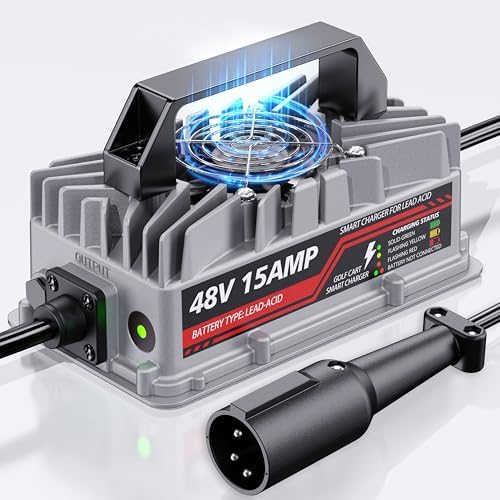
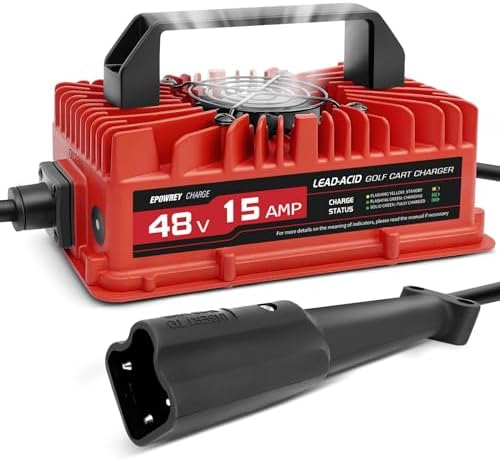
When a 48 volt golf cart charger is beyond repair, choosing the correct replacement requires matching system voltage, output amperage, and connector type to the platform. The three product options below cover the most common 48V platforms.


Frequently Asked Questions About 48 Volt Golf Cart Charger Problems
Why won’t my 48 volt golf cart charger turn on?
The most common causes are pack voltage below the charger’s auto-start threshold (below approximately 40V on a 48V system), a faulty charge port receptacle, or an OBC fault on EZGO RXV and Club Car Precedent models. Test pack voltage first. If the pack reads above 40V and the charger still does not start, test charger output voltage directly at the output terminals. If the charger outputs correct voltage but the cart does not charge, the fault is in the cart’s charge circuit or OBC, not the charger.
What should a 48V golf cart battery pack read when fully charged?
A healthy 48V lead-acid pack reads approximately 50 to 52V at rest when fully charged. Under light load it reads approximately 48 to 50V. The charger’s auto-start threshold on most 48V chargers is approximately 40 to 42V. A pack reading below 40V at rest has a battery problem that must be addressed before normal charging can resume.
Can I repair a 48 volt golf cart charger myself?
Yes, for accessible faults like a blown fuse, a corroded output connector, or a failed relay. These repairs require basic electrical skills and a multimeter. Diode and circuit board replacement require soldering skills and the correct replacement components. For most cart owners, a charger with an internal component failure beyond the fuse is more economically replaced than repaired, since replacement chargers in the $80 to $150 range typically cost less than professional repair labor.
What is the OBC on a golf cart and how does it affect charging?
The OBC (onboard computer) on EZGO RXV and Club Car Precedent models controls the charging circuit. It must receive a signal from the charger before allowing current to flow into the batteries. A failed OBC blocks charging even when the charger and pack are both functioning correctly. OBC faults on Club Car Precedent are displayed as fault codes on the dash charge indicator. On EZGO RXV, setting the tow/run switch to Tow bypasses the OBC charge control and confirms whether the OBC is the fault.
How do I recover a 48V golf cart pack that is too discharged to charge?
Use a 12V automotive battery charger to individually charge each battery in the string to a surface charge before reconnecting them. Charge each battery at 2 to 4 amps for 30 to 60 minutes. After all batteries have been individually surface-charged, reconnect the pack and measure total voltage. If the pack voltage is now above 40V, the golf cart charger’s auto-start circuit should activate normally. Batteries that will not accept a charge individually have failed and need replacement.
About the Author
Chuck Wilson spent decades as a golf cart and small vehicle mechanic before retiring. His shop work covered Club Car, EZGO, and Yamaha platforms across gas and electric drivetrains. He runs GolfCartTips.com in retirement, writing about repairs and maintenance based on jobs he has actually done, not manufacturer talking points. If a procedure is on this site, it has been performed on a real cart.
Last verified on: EZGO TXT 48V, EZGO RXV 48V, Club Car DS 48V, Club Car Precedent 48V, Yamaha Drive 48V. Voltage thresholds cross-referenced against EZGO, Club Car, and Yamaha service manuals and EZGO PowerWise, Lester, and Delta-Q charger documentation.