Golf Cart Tire Pressure: Correct PSI by Platform and Tire Type
Golf cart tire pressure for most stock turf tires falls between 15 and 22 PSI depending on the platform. That range is narrower than the 20 to 30 PSI figure that circulates online, and the difference matters. Running a Club Car DS at 25 PSI on turf tires will wear the center tread prematurely and give a harsh ride. Running a lifted cart with low-profile 205/50-10 street tires at 15 PSI will damage the sidewall. The correct number depends on the tire type and the cart it is on. This article covers the platform-specific PSI targets, how to check pressure correctly, and what happens to tire wear when the pressure is wrong.
Last verified: Club Car DS 48V electric, EZGO TXT 48V electric, Yamaha Drive2 | June 2026 | Carlisle All Trail 18×8.50-8, Duro HF-273 205/50-10
Key Takeaways
- The widely repeated “20 to 30 PSI” range for golf cart tires is wrong for most stock configurations. Club Car DS and EZGO TXT factory turf tires run 15 to 18 PSI per OEM service documentation. Running them at 25 PSI accelerates center tread wear and hardens the ride without any safety benefit. Always check the actual tire sidewall max rating and the OEM spec for your platform, not a generic internet figure.
- Always check tire pressure cold, meaning before the cart has been driven. A tire that reads 20 PSI after a 30-minute run is actually running at 16 to 18 PSI cold. Heat increases pressure by 2 to 4 PSI. Checking after driving and then inflating to target PSI will leave the tire overinflated once it cools. The cold check is the only accurate reading.
- Tire pressure drops 1 to 2 PSI per month under normal conditions, more during temperature swings. A tire correctly set at 18 PSI in October can be at 12 PSI by January in a cold climate. Low pressure generates heat inside the casing on every drive, accelerating internal rubber breakdown independent of tread depth. Monthly checks cost two minutes and prevent premature casing failure.
Correct Golf Cart Tire Pressure by Platform
These are the OEM-sourced pressure targets for the most common residential golf cart platforms on factory-installed turf tires. If your tires have been replaced with a non-factory size or type, use the sidewall maximum as your ceiling and stay 3 to 5 PSI below it for normal use.

| Platform | Tire Size | Front PSI | Rear PSI | Source |
|---|---|---|---|---|
| Club Car DS (all years) | 18×8.50-8 turf | 15 to 18 | 15 to 18 | Club Car DS Service Manual |
| EZGO TXT (all years) | 18×8.50-8 turf | 15 to 20 | 15 to 20 | EZGO TXT Service Manual |
| Club Car Precedent | 18×8.50-8 turf | 15 to 18 | 15 to 18 | Club Car Precedent Service Manual |
| Yamaha Drive / Drive2 | 18×8.50-8 turf | 18 to 22 | 15 to 20 | Yamaha Drive2 Service Manual |
| Lifted carts (low-profile street) | 205/50-10 or 215/35-12 | Per sidewall | Per sidewall | Tire sidewall max rating |
The Yamaha Drive and Drive2 front PSI runs slightly higher than Club Car and EZGO because of the Yamaha’s front suspension geometry. The front spindle and A-arm angles on the Drive platform put more load on the outer edge of the front tire at lower pressures, causing faster outer shoulder wear. Running at 18 to 22 PSI front keeps the contact patch flat and distributes load evenly.
For lifted carts with low-profile street tires, do not apply the 15 to 20 PSI range from the stock turf tire spec. A 205/50-10 street tire typically requires 20 to 25 PSI. The sidewall max rating on your specific tire is the authoritative number. Running a low-profile tire at 15 PSI causes the sidewall to flex excessively under cornering load, which generates heat and eventually deforms the internal cords. Check the sidewall, not the stock OEM spec, for any non-factory tire fitment.
How to Check Golf Cart Tire Pressure Correctly
Checking golf cart tire pressure takes two minutes when done correctly and gives you a reading that actually means something. The two most common errors are checking after driving and using a gauge that is not accurate at low pressures.
Check Cold, Before Driving
Always check pressure cold. Cold means the cart has not been driven in the last two hours. Driving generates heat inside the tire, and heat increases air pressure by 2 to 4 PSI at golf cart operating temperatures. A tire that reads 20 PSI after a 30-minute run is actually at 16 to 18 PSI cold. If you inflate to 18 PSI after driving, the tire will be at 22 PSI cold the next morning. That puts a Club Car DS turf tire 4 PSI over spec and will accelerate center tread wear.
If you can only check after driving, note the reading and subtract 2 to 3 PSI to estimate the cold pressure. Then verify the next morning before the first drive to confirm.
Use a Gauge That Is Accurate at Low Pressures
Most gas station inflator gauges are designed for passenger vehicle tires in the 30 to 50 PSI range. At 15 to 20 PSI, their accuracy degrades and readings can be off by 3 to 5 PSI in either direction. That margin of error is large enough to matter on a golf cart tire. Use a dedicated low-pressure dial gauge or a digital gauge rated for 0 to 60 PSI. A quality gauge in that range costs $10 to $20 and will give consistent, accurate readings at golf cart pressures.
Reading the Valve Stem
The valve stem on a golf cart wheel is a standard Schrader valve, the same as on a passenger car. It is a small rubber-mounted metal tube protruding from the wheel rim, usually on the inside face of the wheel. On some aftermarket golf cart wheels, the valve stem may be positioned at an angle or recessed into the wheel design, which can make it harder to seat a gauge straight. If the gauge hisses when you press it on, the stem is not fully seated. Press firmly and straight, not at an angle.
A brief hiss as you remove the gauge is normal. Continuous hissing while the gauge is on means air is escaping past the gauge seal and the reading will be low. To check: remove the valve stem cap, press the gauge straight onto the stem, read the pressure, and replace the cap. The cap is not decorative. It keeps dirt and moisture off the valve core, which is what actually holds air in the tire. A missing cap on a cart stored outside lets the valve core corrode, which can cause a slow leak.

- PROCESS LEVEL ACCURACY: This heavy duty tire pressure gauge is calibrated manually to ANSI B40.1 Grade A (plus-minus 1% …
- PRESSURE RANGE 0-75 PSI: ETENWOLF’s tire gauge can measure pressure of pickup, motorcycle, truck, bike, SUV, RV or ATV
- EASY TO READ IN THE DARKNESS: The large glow dial helps you clearly read the pressure at night or in low light
How to Add or Release Air from Golf Cart Tires
Adding Air
A portable 12V air compressor is the best tool for inflating golf cart tires at home. Most cordless or plug-in compressors designed for passenger car tires work fine at golf cart pressures. Set the target PSI on the compressor if it has a preset function, or inflate in short bursts and check with your gauge between each burst. Golf cart tires are small volume. Adding air at a compressor that is set for 35 PSI and walking away will over-inflate the tire before you get back to it.
Gas station inflators work but require care. The inflator tip locks onto the valve stem and runs continuously. At 15 to 20 PSI target, the tire fills faster than you expect. Press the inflator on, count three seconds, release, and check with your own gauge. The station inflator gauge is not accurate at these pressures. Use it only to add air, and verify with your gauge each time.
If the tire is flat or nearly flat (below 5 PSI), check the tire and rim for visible damage before inflating. A tire that has been run flat even for a short distance may have internal cord damage that makes it unsafe to reinflate. Inspect the sidewall and bead area before adding air.
Releasing Air
To release air from an overinflated tire, press a small tool (a pen cap, tire gauge tip, or dedicated valve core tool) against the pin inside the valve stem. The pin is in the center of the stem opening. Pressing it inward lets air out. Release in short bursts and re-check with the gauge each time. It takes less pressure to push the pin than most people expect, and it is easy to release too much air and have to add it back. A valve core tool with a built-in gauge makes this process faster and more controlled.
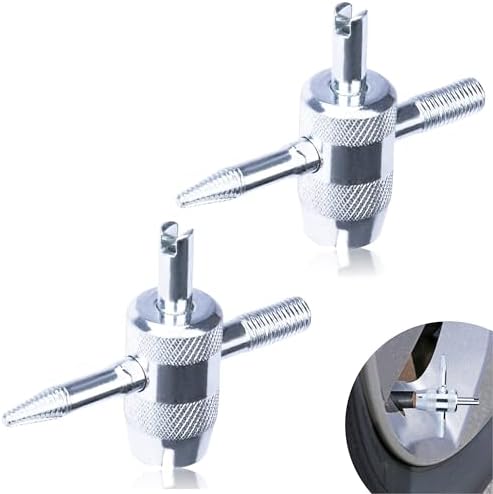
- 4-in-1 Design: Designed to be versatile with four different heads, this valve stem removal tool can be used for removing…
- Durable & Reliable: Made of high-quality metal material with galvanized surface in bright silver color, this tire valve …
- Quantity and Size: You will receive 2 tire valve stem tools, each measuring approximately 48 mm (1.9 inches) long and 33…
Seasonal Pressure Adjustment
Tire pressure changes with ambient temperature at a rate of roughly 1 PSI for every 10 degrees Fahrenheit. A tire set to 18 PSI on a 70-degree day in October will read approximately 14 PSI on a 30-degree morning in January. That 4 PSI drop puts most golf cart turf tires below their minimum spec and into the range where every drive generates excess heat in the casing.
The practical implication: check pressure more frequently in fall and spring when temperatures swing the most. In mid-summer, a tire can run slightly high in the morning and still be within spec by afternoon. In winter, a tire that was at spec the previous afternoon can be noticeably low by the next cold morning. Monthly checks are the minimum. Weekly checks during large temperature swing periods are better.
Do not adjust the target PSI seasonally. The OEM specification does not change with the season. What changes is how often you need to add air to maintain that target. Set the tire to the correct cold PSI regardless of the season, and check it more frequently when temperatures are volatile.
How Wrong Pressure Affects Tire Wear
Pressure errors leave visible signatures in the wear pattern. Reading the tread tells you what has been happening before you reach the point of early replacement.
Center tread wear: The center of the tread is worn more than the shoulders. Caused by consistent overinflation. The tire is riding on the crown of the tread rather than the full contact patch. On a Club Car DS with turf tires at 25 PSI, this pattern typically appears within one season. Correct by reducing to spec and rotating the affected tires to the rear if they still have usable tread depth.
Both shoulder edges worn more than center: The shoulders of the tread are worn more than the center. Caused by consistent underinflation. The tire is flexing outward and riding on the edges of the contact patch. This wear pattern also generates the most heat inside the tire casing and is the fastest path to premature casing failure. On electric carts, underinflated tires increase rolling resistance, which raises motor current draw and shortens the range you get from a full charge. Correct by inflating to spec immediately. If the shoulders are significantly worn, inspect the tire for sidewall cracking or internal deformation before continuing to drive on it.
One-sided edge wear (inner or outer only): Only one edge of the tread is worn more than the other. This is usually not a pressure issue. It indicates a front toe alignment problem or, less commonly, a worn suspension component. Pressure correction will not fix alignment-induced wear. Check the front toe setting before rotating or replacing the tire. The spec on most Club Car DS, EZGO TXT, and Yamaha Drive platforms is 1/8 inch toe-in at the front of the tire. See the golf cart tire rotation guide for more detail on reading wear patterns before rotating.
Uniform wear across the full tread width: Normal. This is what correct pressure and alignment produce. Continue on the same maintenance schedule. For guidance on when tread depth has reached the replacement threshold, see the golf cart tire lifespan guide.
Frequently Asked Questions
What PSI should golf cart tires be?
Most stock golf cart turf tires (18×8.50-8 format) run 15 to 20 PSI depending on the platform. Club Car DS and Precedent: 15 to 18 PSI. EZGO TXT: 15 to 20 PSI. Yamaha Drive and Drive2: 18 to 22 PSI front, 15 to 20 PSI rear. Low-profile street tires on lifted carts: check the sidewall max rating, typically 20 to 25 PSI. The widely repeated 20 to 30 PSI range is too high for most factory turf tire configurations and will cause premature center tread wear on a standard residential cart.
How do I know if my golf cart tires are overinflated?
The clearest sign is center tread wear: the middle of the tread face wears faster than the shoulders, leaving a worn strip down the center while the outer edges still have depth. A noticeably harsh or bouncy ride on surfaces that used to feel smooth is another indicator. Check with a low-pressure gauge. If the reading is more than 3 PSI above the OEM spec for your platform, reduce pressure to spec and monitor the wear pattern going forward.
Can I use a regular car tire gauge on golf cart tires?
Yes, but accuracy is the concern. Most passenger car gauges are calibrated for 30 to 60 PSI and lose accuracy at the 15 to 20 PSI range of golf cart tires. A reading of 18 PSI on a car gauge could be 15 or 21 in reality. For consistent results, use a gauge rated specifically for low-pressure applications (0 to 60 PSI range). Digital gauges in this range are inexpensive and give more reliable readings at golf cart pressures than a standard pencil-style or stick gauge.
Should I adjust golf cart tire pressure in winter?
The target PSI does not change in winter, but you need to check more often. Tire pressure drops approximately 1 PSI for every 10-degree Fahrenheit drop in temperature. A tire at 18 PSI on a 70-degree October day will be around 14 PSI on a 30-degree January morning. Check pressure before the first drive of the day during cold weather rather than monthly. If you store the cart outside during winter, check it every week. Running consistently underinflated in cold weather degrades the tire casing faster than mileage does.
How often should I check golf cart tire pressure?
At minimum, once a month. During periods of significant temperature change (fall and spring), check weekly. Before any trip longer than normal or when carrying a heavier load than usual, check cold before departure. Tires lose 1 to 2 PSI per month under normal conditions even with no driving. A cart stored for three months without a pressure check can easily be 5 to 6 PSI below spec before it turns a wheel.
What is the maximum PSI for golf cart tires?
The maximum PSI is stamped on the sidewall of your specific tire, not a universal figure. On most 18×8.50-8 turf tires, the sidewall max is 30 to 35 PSI. That is the structural limit of the tire, not the recommended operating pressure. Operating at or near the maximum PSI will cause center tread wear, a harsh ride, and reduced wet-surface traction. Run at the OEM platform spec, which is typically well below the sidewall maximum.
References
Club Car DS and Precedent Service Manuals (2018 editions): tire inflation specifications. Club Car LLC, Augusta, GA.
EZGO TXT Service Manual (2019 edition): tire pressure specifications. Textron Specialized Vehicles, Augusta, GA.
Yamaha Drive2 Service Manual (2020 edition): front and rear tire pressure specifications, front suspension geometry. Yamaha Motor Corporation, USA.
Tire Pressure and Temperature Relationship: 1 PSI per 10 degrees Fahrenheit rule, Tire Guides Inc.
About the Author
Chuck Wilson spent decades as a golf cart and small vehicle mechanic before retiring. His shop work covered Club Car, EZGO, and Yamaha platforms across gas and electric drivetrains. He runs GolfCartTips.com in retirement, writing about repairs and maintenance based on jobs he has actually done, not manufacturer talking points. If a procedure is on this site, it has been performed on a real cart.
Last verified on: Club Car DS 48V electric, EZGO TXT 48V electric, and Yamaha Drive2, June 2026. Carlisle All Trail 18×8.50-8 and Duro HF-273 205/50-10 tires. PSI figures cross-referenced against Club Car DS 2018, EZGO TXT 2019, and Yamaha Drive2 2020 service manuals.