Golf Cart Speed Controller: How It Works, What It Protects, and When to Replace It
A golf cart speed controller is the component that determines how much electrical current flows from the battery pack to the motor at any given moment. Without it, the motor would either run at full power or not at all. There would be no gradual acceleration, no smooth speed changes, and no protection for the motor from the massive current spike that occurs every time the cart starts from a standstill.
This guide covers how the golf cart speed controller works, the difference between old resistor-based systems and modern PWM controllers, what the controller protects against, how to troubleshoot common controller faults, and which replacement controllers fit the most common cart platforms.
Last verified: EZGO TXT 48V, Club Car DS 48V, Club Car Precedent 48V, Yamaha Drive 48V | May 2026 | Covers series-wound DC, AC induction, and brushless DC motor platforms
Key Takeaways
- A golf cart motor draws up to 20 times its normal operating current at the moment of starting from a standstill. This is called locked armature current. The speed controller limits this surge to a safe level and ramps current up gradually as the cart accelerates. Without this ramp-up function, a single hard press of the pedal from a stop would destroy the motor windings within seconds through heat buildup from the uncontrolled current surge.
- Modern AC induction and brushless DC motors found in the EZGO RXV, Club Car Precedent, and Yamaha Drive2 cannot operate at all without a speed controller. These motors require precisely timed current reversals that are synchronized with the motor’s rotational position. The controller generates these timing signals. Remove the controller and the motor is a dead weight regardless of battery charge level.
- A higher amperage replacement controller will not automatically make your cart faster if the motor and governor limits are still in place. A 400A controller on a cart with a stock motor and governor setting will produce the same top speed as the stock controller. The amperage rating determines how much current the controller can sustain, which affects torque and hill performance more than top speed. Matching the controller to the motor’s actual requirements is more important than maximizing amperage.
Golf Cart Speed Controller: What It Actually Does
The golf cart speed controller sits between the battery pack and the motor. It receives a signal from the accelerator pedal, either through a mechanical potentiometer on older carts or a throttle inductance coil on newer ones, and uses that signal to determine how much current to deliver to the motor at any given moment. As the pedal is pressed further, the signal voltage increases, the controller responds by increasing current delivery, and the motor speeds up. As the pedal is released, the opposite occurs.
On a modern pulse width modulation (PWM) controller, the controller does not vary voltage to the motor directly. Instead, it rapidly switches the full battery voltage on and off to the motor at high frequency. The ratio of on-time to off-time in each cycle is the pulse width. A 25 percent duty cycle means the motor receives full voltage for 25 percent of each cycle and no voltage for the other 75 percent.
At 75 percent duty cycle, the motor receives full voltage for three quarters of each cycle. The motor’s inductance smooths these pulses into what feels like a continuously varying voltage. This switching approach is far more efficient than resistance-based speed control because it wastes virtually no energy as heat in the control circuit itself. For a deeper technical explanation of how PWM switching works in DC motor applications, the Battery University guide to DC motor electrical characteristics covers the underlying principles in plain language.
Golf Cart Speed Controller: Old Resistor Systems vs Modern PWM
Understanding the history of golf cart speed control explains why modern controllers behave differently from vintage carts and why the two systems require completely different diagnostic approaches.
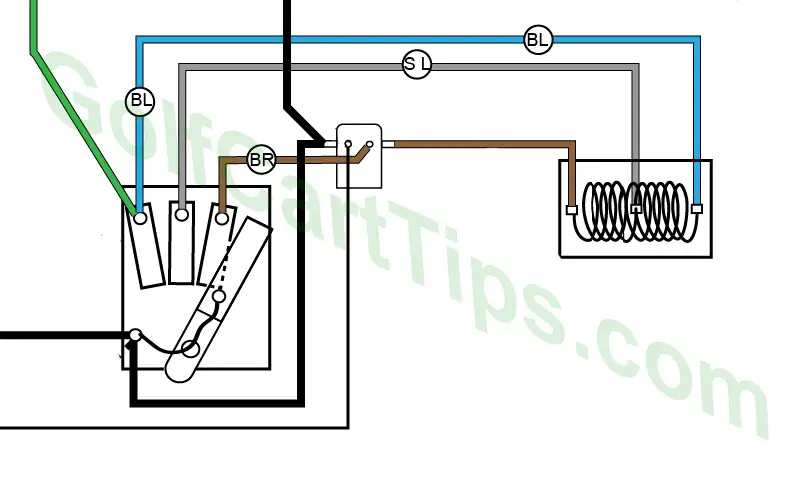
Early electric golf carts from the 1960s through the mid-1980s used resistor-based speed control. The Yamaha G1E is a good example. The speed controller assembly contained a resistor coil with multiple contact taps, and a wiper arm moved across the taps as the pedal was pressed. Each contact position connected the motor through a different amount of resistance, reducing voltage to the motor at lower speed positions.
This is why vintage carts have distinct speed steps rather than smooth continuous acceleration. The resistors converted the difference between battery voltage and motor voltage into heat, which was wasted energy. The system was simple and reliable but inefficient. Our Yamaha G1 solenoid wiring guide covers this resistor coil system in detail with full diagrams for anyone working on a G1E.
Other early systems controlled speed by re-routing battery connections through solenoids. Three 6V batteries in series produced 18V for low speed. Six 6V batteries produced 36V for full speed. Intermediate speeds used different combinations of series and parallel battery connections, sometimes passing through resistors to further reduce voltage. Each speed step required a separate solenoid to switch the battery routing. A cart with five speed steps might have five or more solenoids, all of which were wear items that needed periodic inspection and replacement.
Modern PWM controllers replaced all of this with a single solid-state unit that produces smooth, stepless speed control with minimal energy waste. The transition began in the early 1990s with series-wound DC motor controllers and became universal with the introduction of AC induction and brushless DC motors in the 2000s. A modern EZGO RXV or Club Car Precedent controller is a sophisticated piece of electronics that manages motor timing, monitors temperatures, reads battery state of charge, and communicates error codes, all in a sealed unit with no moving parts.
Golf Cart Speed Controller: 5 Protection Functions
The protection functions built into a modern golf cart speed controller are as important as its speed control function. These protections prevent damage to the motor, the controller itself, the battery pack, and the wiring harness under abnormal operating conditions.
Golf Cart Speed Controller Function 1: Locked Armature Current Limiting
When a DC motor starts from a standstill, the back-EMF (back electromotive force) that normally limits current through the windings is zero. The motor’s winding resistance is very low, typically less than one ohm. Without current limiting, Ohm’s law dictates that a 48V pack would push very high current through the windings immediately.
Real motors have even lower winding resistance, meaning the initial current surge can reach 20 times the normal operating current. The controller limits this surge to a safe level and ramps current up over the first second or two of motion, protecting the windings from heat damage.
Golf Cart Speed Controller Function 2: Overcurrent Protection
Under sustained heavy load, a steep hill, a heavily loaded cart, or a mechanical drag from a seized bearing, the motor draws more current than its rated operating level. The controller monitors current continuously and reduces output when current exceeds the programmed limit. This prevents the motor windings from overheating under sustained high-load conditions.
On carts with a programmable controller, the current limit can be adjusted upward for performance applications, but doing so transfers the thermal risk from the controller to the motor and requires confirming the motor can handle the increased continuous current.
Golf Cart Speed Controller Function 3: Thermal Shutoff
The controller’s power transistors generate heat during operation. Under sustained heavy load or in a hot environment, this heat can reach levels that would damage the transistors permanently. The controller monitors its internal temperature with a thermistor and reduces output power as temperature approaches the safe operating limit.
In severe cases it shuts down entirely until temperature drops to a safe level. A cart that progressively loses power on a long hill and then stops but starts again after a rest break is showing controller thermal limiting behavior, not motor failure. If you are unsure whether the fault is the controller or the motor, see our golf cart motor troubleshooting guide for the steps to distinguish between the two before replacing either component.
Golf Cart Speed Controller Function 4: Battery Voltage Monitoring
The controller continuously monitors battery pack voltage during operation. When pack voltage drops below a programmed low-voltage cutoff threshold, the controller reduces power output and eventually shuts the cart down before the pack reaches complete discharge. Discharging a lead-acid pack to zero volts causes permanent plate damage.
The low-voltage cutoff protects the pack from this damage by stopping the cart before it reaches a critical state. The cutoff voltage is typically set around 42V on a 48V system for lead-acid packs. Lithium packs with a built-in BMS handle their own low-voltage protection, but the controller’s cutoff provides a secondary layer of protection.
Golf Cart Speed Controller Function 5: Ground Fault Protection
A ground fault occurs when a live wire comes into contact with the cart’s metal frame, creating an unintended current path. On a 48V system, this can cause immediate high current flow through the frame that damages wiring, components, and in extreme cases creates a fire risk. The controller detects ground faults by monitoring current balance in the circuit and shuts down immediately when an imbalance indicating a ground fault is detected. This protection is particularly important on carts used in wet conditions where moisture ingress into wiring connectors is more likely.
Golf Cart Speed Controller: Troubleshooting Common Faults
Controller faults produce distinct symptom patterns that differ from battery, solenoid, and motor faults. Knowing which symptom points to which component saves time and money on diagnosis.
A cart that clicks when the pedal is pressed but does not move points to the solenoid first, not the controller. The solenoid click indicates the controller is sending a signal to the solenoid coil, which means the controller input circuit is functioning. The bypass test on the solenoid confirms whether the solenoid main contact is failing. If the solenoid bypasses correctly and the motor still does not run, the controller output circuit is suspect.
A cart that moves but progressively loses power before recovering after a rest period is showing thermal limiting. Check that the controller housing vents are clear and that the controller is not mounted in a location that traps heat. On EZGO TXT and Club Car DS models, the controller is typically mounted under the seat where airflow is limited. Confirm the mounting screws are tight and the controller is making good thermal contact with its mounting surface, as the frame acts as a heat sink in many installations.
A cart that operates normally at low speed but loses power or cuts out at higher speeds often has a battery pack that cannot sustain the higher current demand at full throttle. Test the pack under load at full throttle with a clamp meter measuring current and a multimeter measuring pack voltage simultaneously. If pack voltage drops significantly at full throttle while current is within the controller’s normal range, the battery pack is the fault, not the controller.
Error codes on modern EZGO RXV and Club Car Precedent controllers are read through the onboard diagnostic system. On the RXV, the controller communicates fault codes through a series of LED flashes visible through the controller housing. On the Precedent, fault codes are read through the battery charge indicator display on the dash. Consult the platform-specific service manual for the fault code list before replacing any component based on a code alone, many controller fault codes indicate a sensor or wiring fault rather than a failed controller.
| Symptom | Most Likely Cause | First Check |
|---|---|---|
| Click, no movement | Solenoid main contact failed | Solenoid bypass test |
| No click, no movement | Battery, key switch, or microswitch | Voltage at controller input terminals |
| Progressive power loss on hills, recovers after rest | Controller thermal limiting | Controller temperature, vent clearance |
| Power loss at full throttle only | Battery pack sag under high load | Pack voltage under full throttle load |
| Jerky acceleration from stop | Potentiometer or throttle coil fault | Throttle signal voltage at controller input |
| Cart runs at one speed only | Throttle signal stuck or potentiometer failed | Throttle signal range across full pedal travel |
| Error code displayed | Sensor, wiring, or controller fault | Platform-specific fault code table in service manual |

Golf Cart Speed Controller: Choosing the Right Replacement
Choosing a replacement golf cart speed controller requires matching four specifications to your cart: system voltage, motor type, amperage rating, and physical compatibility with the mounting location and connector pinout. Getting any of these wrong results in a controller that either does not work at all or damages the motor through incorrect current delivery.
System voltage must match exactly. A 48V controller on a 36V cart will not function correctly. A 36V controller on a 48V cart will likely be destroyed immediately on power-up. Confirm your system voltage by counting the batteries and multiplying by cell voltage, or by measuring pack voltage with a multimeter.
Motor type determines the controller type. Series-wound DC motors require a series DC controller. AC induction motors require an AC controller programmed for the specific motor. Brushless DC motors require a brushless controller matched to the motor’s pole count and timing parameters. Swapping a series DC controller for an AC controller or vice versa is not possible, these are fundamentally different motor control technologies.
Amperage rating should match or slightly exceed the motor’s rated continuous current draw. For a stock EZGO TXT series-wound motor rated at 275A continuous, a 300A controller is appropriate. Installing a 500A controller does not improve performance on a stock motor, the motor’s physical limitations cap current draw before the controller’s limit is reached. A higher amperage controller is appropriate when upgrading to a higher-performance motor that can sustain more continuous current.
For lightweight carts on flat terrain, a 200 to 300A controller is typically adequate. For carts carrying heavy loads or operating on significant hills, 300 to 500A provides more thermal headroom under sustained high-load conditions. Fleet operators running carts through multiple rounds per day benefit from the higher-rated controllers because they run cooler under sustained use and have a longer service life in that environment.
Platform-Specific Replacement Controllers
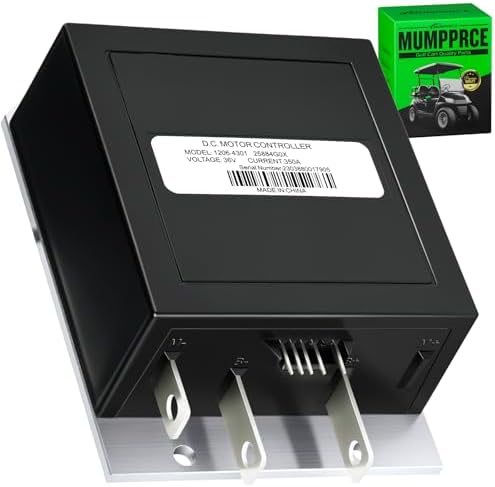
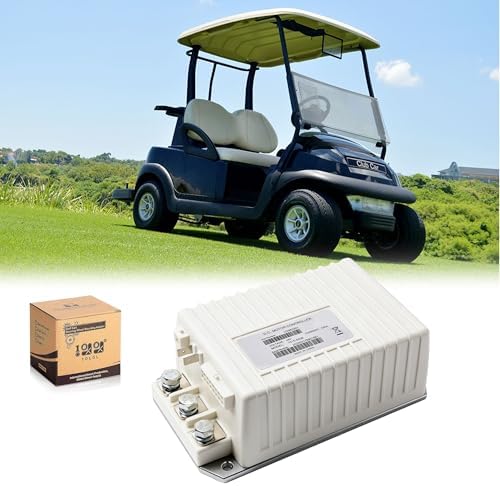
The following replacement controllers are the most commonly used aftermarket options for the major platforms. Confirm your specific model year and motor type before ordering, EZGO and Club Car changed controller specifications across model years and not all controllers within a platform line are interchangeable.

Golf Cart Speed Controller: Frequently Asked Questions
What does a golf cart speed controller do?
A golf cart speed controller regulates how much current flows from the battery pack to the motor based on accelerator pedal position. It ramps current up gradually from a stop to prevent damage from the locked armature current surge, provides smooth variable speed control through PWM switching, protects the motor and itself from overcurrent and overheating, monitors battery voltage to prevent complete discharge, and detects ground faults. On AC and brushless DC motor carts, it also generates the precisely timed current reversals the motor requires to function at all.
Will a higher amp controller make my golf cart faster?
Not necessarily. A higher amperage controller increases the maximum current available to the motor, which improves torque and hill performance. Top speed is determined by the motor’s back-EMF limit and any governor setting, not the controller’s amperage rating. To increase top speed, you also need to adjust or remove the governor and potentially upgrade the motor. A higher amperage controller is a necessary part of a performance upgrade but is not sufficient on its own.
How do I know if my golf cart speed controller is bad?
Rule out the battery pack, solenoid, and throttle signal before condemning the controller. Confirm the pack delivers full voltage under load. Confirm the solenoid bypasses correctly. Confirm the throttle signal varies smoothly across the full pedal range. If all three check out and the cart still does not operate correctly, measure voltage at the controller’s output terminals with the pedal pressed. No output with confirmed input voltage and a correct throttle signal points to a failed controller output stage.
What is the difference between a series DC controller and an AC controller?
A series DC controller varies DC current to a series-wound DC motor. An AC controller converts DC battery power into three-phase AC current timed precisely to the AC motor’s rotational position using signals from a resolver or encoder on the motor shaft. They are not interchangeable. Series DC controllers are found on older EZGO TXT, Club Car DS, and Yamaha Drive models. AC controllers are found on EZGO RXV, Club Car Precedent IQ Plus, and Yamaha Drive2 models. Confirm your motor type before purchasing any replacement controller.
Can I program my golf cart speed controller?
Some controllers are programmable and some are not. Stock EZGO TXT and Club Car DS controllers from the factory have fixed settings that cannot be adjusted without replacement. Aftermarket performance controllers from Alltrax, Curtis, and Navitas are programmable via a handheld programmer or laptop interface, allowing adjustment of current limit, acceleration ramp rate, speed limit, and other parameters. EZGO RXV and Club Car Precedent controllers can be accessed through the manufacturer’s diagnostic tool to adjust certain settings within a defined range.
About the Author
Chuck Wilson spent decades as a golf cart and small vehicle mechanic before retiring. His shop work covered Club Car, EZGO, and Yamaha platforms across gas and electric drivetrains. He runs GolfCartTips.com in retirement, writing about repairs and maintenance based on jobs he has actually done, not manufacturer talking points. If a procedure is on this site, it has been performed on a real cart.
Last verified on: EZGO TXT 48V series-wound DC, EZGO RXV 48V AC induction, Club Car DS 48V series-wound DC, Club Car Precedent 48V AC induction, Yamaha Drive 48V series-wound DC. Controller specifications cross-referenced against EZGO, Club Car, and Yamaha service manuals and Alltrax, Curtis, and VEVOR product documentation.