Golf Cart Safety: How to Avoid the Accidents That Actually Happen
Golf cart safety tips are not obvious to everyone who steps into a cart for the first time. Golf carts look simple. They go slowly. They have no engine hood to open, no complex controls, and no manual transmission. None of that makes them safe by default.
Golf carts are involved in approximately 15,000 emergency room visits per year in the United States according to CPSC injury data, and rollover accidents account for a significant portion of serious injuries. Most of those accidents are preventable. This guide covers the nine safety rules that eliminate the most common causes of injury, on the golf course and on the road.
Last verified: On-course and street-legal golf cart operation guidelines | May 2026 | Street-legal requirements vary by state, confirm local rules with your DMV before operating on public roads
Key Takeaways
- Passenger ejection is the primary cause of serious golf cart injuries. When a cart stops suddenly, turns sharply, or rolls over, any passenger not holding on and seated properly inside the vehicle is at high risk of ejection. Seatbelts reduce ejection risk significantly. On carts without seatbelts, all passengers must be seated fully inside the vehicle with both feet on the floor and both hands gripping the cart’s hand holds before the cart moves. This is not a suggestion, it is the single most effective safety measure available on a standard golf cart.
- Golf cart rollover accidents are strongly associated with slope traversal. Driving across a slope at an angle, rather than straight up or straight down, shifts the cart’s weight distribution toward the downhill wheels and dramatically reduces rollover resistance. A cart that is stable on a flat surface can roll over on a 15-degree transverse slope. The correct technique on any slope is to drive straight up or straight down. If the slope is too steep to drive straight and safely, stop the vehicle, set the parking brake, and walk.
- Operating the golf cart while on public roads requires compliance with all vehicle traffic laws and rules, including speed limits, lane discipline, traffic signals, and yield requirements at intersections. Golf carts are not exempt from traffic laws on roads where they are permitted to operate. A golf cart driver on a public road has the same legal obligations as any other vehicle operator. Violations carry the same legal consequences.
Golf Cart Safety Tips: Seatbelts and Passenger Ejection Risk
Wear seatbelts anytime the vehicle is in motion if the cart is equipped with them. Golf cart seatbelts are lap belts, not shoulder harnesses, but even a lap belt significantly reduces the risk of passenger ejection in a sudden stop or rollover. Many fleet golf carts at public courses are not equipped with seatbelts. Privately owned and street-legal carts are more likely to have them. If your cart does not have seatbelts, the safe seating position is both feet flat on the floor and both hands holding the hand holds provided on the cart’s dashboard or roof frame.
The risk of passenger ejections increases significantly in three situations: sudden braking from speed, sharp turns taken too fast, and rollover events. In a sudden stop, the forward momentum of a passenger who is sitting sideways, hanging legs outside the cart, or leaning forward carries them out of the seat before they can react. In a rollover, a passenger who is not seated inside the vehicle is crushed by the cart rather than protected by it. Neither scenario is survivable at even modest golf cart speeds without the protection of being fully inside the vehicle.
Children under a certain height should not ride in the front passenger seat of carts without footrests they can actually reach. A child who cannot brace their feet on the floor has no lower body stability and is more vulnerable to ejection. Many courses have age or height minimums for cart passengers. Follow them even when the course is not actively enforcing them.
Golf Cart Safety Tips: Rollover Prevention on Slopes
Golf cart rollover accidents are the most serious category of golf cart injury. The physics are straightforward. A golf cart has a high center of gravity relative to its track width. On flat ground this is not a problem. On a slope, particularly a transverse slope where the cart is driven across rather than up or down, the high center of gravity combined with the side-load of gravity creates a tipping moment that the narrow track width cannot resist beyond a certain angle.
The rule is simple: drive straight up slopes and drive straight down slopes. Never traverse a slope at an angle. If you cannot approach a destination by going straight up or straight down a slope, find another route that does not require transverse slope driving. The stability margin on a transverse slope shrinks faster than most drivers expect, particularly when there is a passenger on the uphill side of the cart.
Additional rollover risk factors include sharp turns taken at speed, driving on soft or uneven surfaces that cause one wheel to drop suddenly, and braking sharply while turning. Reduce the risk of rollover by decelerating before turns, not during them. Slow down to a safe turning speed, make the turn smoothly, then accelerate out of it. On uneven terrain, slow to a pace where a sudden wheel drop does not have enough momentum to continue into a full rollover.
If you sense a rollover beginning, do not attempt to jump clear. The cart moves faster than you can react, and the most common serious injury in a rollover is being caught under the cart during an attempted exit. Stay in the seat, hold on, and keep your body inside the vehicle. The roll bar or roof frame of the cart provides protection only to passengers who remain inside the vehicle.

- Retractable seat belt bracket Kit fits most 4 passenger (2+2 rear seat), such as EZGO TXT RXV, Club Car DS Precedent and…
- DOT-approved seat belts, sturdy brackets, make your cart legal for street use and keep passengers more safty while the v…
- Retractable Belt length: 42″, Bracket size: 35″ x 6.9″, Seat Belts with buckles made in metal zinc. It’s convenient and …
Golf Cart Safety Tips: Golf Cart Lane and Street Driving Rules
Operating the golf cart on public roads requires full compliance with all vehicle traffic laws and rules. A golf cart lane may be designated on some roads in golf communities, retirement communities, and resort areas. Where a golf cart lane exists, use it. Where no golf cart lane is designated, the golf cart operates in the standard traffic lane as any slow-moving vehicle would, typically as far right as safely practicable.
Merge and lane change procedures for a cart are the same as for any vehicle. Check mirrors, signal the intended direction using the cart’s turn signals or hand signals if the cart has no turn signals, check blind spots, and merge when clear. The size and limited visibility of a golf cart compared to surrounding vehicles means other drivers may not see it easily, particularly when approaching from the rear. Drive defensively and assume other drivers have not seen the cart until they demonstrate they have by their behavior.
At intersections, obey all vehicle traffic signals. Yield to pedestrians in crosswalks. Yield to cross traffic when required by signage. Do not attempt to make a left hand turn across multiple lanes of traffic on a busy road in a golf cart. The cart’s acceleration is too slow to safely execute a gap-dependent left turn at a standard intersection. Use a dedicated left turn lane or find an intersection with a protected left turn signal. If neither is available, turn right and find a legal U-turn point instead.
Speed limits must be obeyed. Most golf carts are governed to 15 to 25 mph. Most jurisdictions that permit golf carts on public roads restrict them to roads with posted speed limits of 35 mph or less. Confirm your state’s specific requirements. A useful reference for baseline federal vehicle traffic laws is the NHTSA road safety resource center, though golf cart-specific rules are set at the state and municipal level.
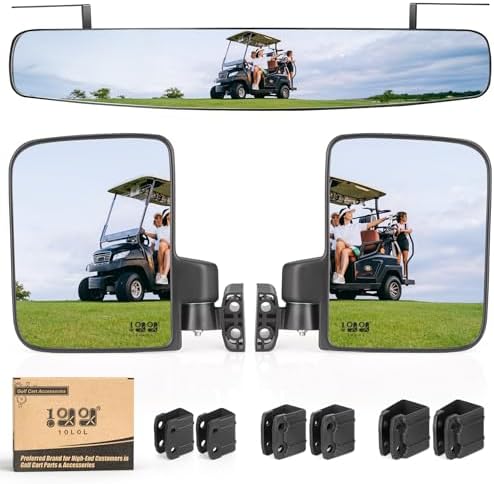
- Universal Golf Cart Mirrors: Suitable for most golf carts, such as Club Car DS Precedent,EZGO TXT RXV,Yamaha G2-G29,Temp…
- 270° panoramic rotation: Our golf cart rear view mirror rotates 270° and features a curved design to see everything behi…
- No-Drilling Required: Our golf cart side mirrors can be installed in minutes without the use of tools and without worryi…
Golf Cart Safety Tips: Pedestrians and Inclement Weather
Golf carts and pedestrians share space on golf courses, in retirement communities, on college campuses, and in resort areas. The pedestrian always has the right of way. Slow to a walking pace when approaching pedestrians from behind on a path. Do not assume they hear you coming. Electric carts are nearly silent at low speed and a pedestrian focused on something else may step sideways into the cart’s path without warning. Approach slowly enough to stop without incident regardless of their behavior.
The golf cart may shield the view of small pedestrians, particularly children, from surrounding vehicle traffic. When operating in shared pedestrian and vehicle traffic environments, be aware that the cart’s roof and body panels reduce your visibility of low objects in front of the cart. A child who is shorter than the cart’s dashboard is not visible from the driver’s seat until the cart is already on top of them. Drive slowly in areas where children are present.
Inclement weather changes every aspect of golf cart operation. Rain reduces tire traction on cart paths and grass surfaces. Wet grass has significantly less grip than dry grass, and a cart traveling at normal speed on wet fairway turf may not be able to stop within the distance needed to avoid an obstacle. Reduce speed significantly in wet conditions. Allow at least twice the normal stopping distance.
Lightning is a serious risk to golf cart occupants. The cart’s roof provides no protection from lightning. At the first sound of thunder, leave the cart, avoid tall trees and open fairways, and move to a permanent structure. The USGA and most courses have a lightning suspension protocol, if a horn sounds the lightning warning, stop play immediately. Do not continue operating the golf cart to reach shelter faster. Park the cart and proceed on foot to the nearest shelter building.
Golf Cart Safety Tips: Avoid Distractions While Operating the Golf Cart
Avoid distractions while operating the golf cart at all times. Avoid talking on a phone, texting, or handling any device while the vehicle is in motion. Avoid talking to passengers in a way that takes your eyes off the path ahead. Avoid reaching for items in the cart while driving. Avoid looking at a scorecard or GPS screen for more than a moment at a time.
The combination of the cart’s limited stability and its operation in close proximity to pedestrians, other carts, and hazards means that even a one-second distraction can produce a collision or rollover that would not occur if the driver were fully attentive. Golf carts do not have the passive safety systems of a car. There is no anti-lock braking, no electronic stability control, and no crumple zone. The driver’s attention is the primary safety system.
Never drive recklessly or use the cart for joy riding at elevated speeds. The cart’s stability systems are not designed for aggressive driving. Racing between holes, making sharp turns at full throttle, or carrying more passengers than the cart is rated for all increase the risk of rollover and ejection accidents substantially. Most serious golf cart injuries happen exactly this way, on private property, at low speed, by people who did not think anything could go wrong.
Golf Cart Safety Tips: Unattended Cart Procedure
Never leave the golf cart while unattended on a slope without applying the parking brake and shifting the forward/reverse switch to neutral. A cart left with the engine running or electric circuit energized on a slope can begin moving if a passenger or bystander accidentally contacts the pedal. A cart left in gear on a slope will roll when weight is added or removed from the seat.
The correct procedure when leaving the cart: set the parking brake, move the forward/reverse switch to neutral, and turn the key to off. On electric carts, confirm the key is off before stepping away. Do not rely on the cart’s grade-holding capability without the parking brake engaged. The wheel brakes on most golf carts are drum brakes adjusted for moderate grade holding, not for indefinite unattended parking on significant slopes.
Keep children away from the cart when it is unattended. A child who climbs into a golf cart and contacts the accelerator with the key in the on position can cause the cart to lurch forward or backward immediately and without warning. Remove the key from the cart when leaving it in any area where children may be present.
Golf Cart Safety Tips: Impaired Driving
Do not drive intoxicated. Operating a golf cart while impaired by alcohol or drugs carries the same legal risk as operating any other motor vehicle while intoxicated in most jurisdictions. Many states explicitly classify golf carts as motor vehicles for DUI purposes. The legal consequences, fines, license suspension, and potential criminal charges, apply regardless of whether the cart is operated on a public road or on private property such as a golf course.
Beyond the legal risk, the physical risk is significant. Impaired driving reduces reaction time, spatial judgment, and the ability to maintain the precise throttle and steering control that slope driving and pedestrian avoidance require. Golf cart rollover accidents and pedestrian collisions have a strongly disproportionate rate of alcohol involvement compared to other cart accidents. The cart’s low speed does not reduce this risk, most serious golf cart injuries occur at speeds under 15 mph.
Golf Cart Safety Tips: Street Legal Equipment Requirements
Operating a golf cart legally on a public road requires meeting the street-legal equipment standards set by your state. Most states require some combination of the following: working headlights, tail lights, brake lights, turn signals, reflectors, mirrors, a horn, a windshield with wiper, and seat belts. Some states also require a speedometer, a license plate, registration, and liability insurance.
Requirements vary significantly by state. Arkansas, for example, specifies requirements under state code Title 14 for golf carts on city streets. California has different requirements. Florida permits golf carts on roads with speed limits of 35 mph or less under specific equipment conditions. Before operating your cart on any public road, verify the current requirements with your state’s DMV. Do not rely on what a neighbor or dealer tells you, check the current state code directly.
For a complete guide to making your cart legal for street use, see our article on how to make a golf cart street legal, which covers equipment requirements and the registration process for the most common states.

- [Premium Lighting Upgrade]:Upgrade your golf cart with this deluxe light kit, designed for 1996-2013 gas and electric ca…
- [Bright Path Lighting]:Illuminate your journey with the powerful LED headlights and taillights included in this kit Offe…
- [Easy Installation]:This deluxe LED golf cart light kit comes with all the tools you’ll need for a quick and simple inst…
Golf Cart Safety Tips: Maintenance for Safety
A cart that is not mechanically sound is a safety risk regardless of how carefully it is driven. Brake failure, tire blowout, and steering component failure are all rare but possible on a poorly maintained cart and each can cause an accident that careful driving cannot prevent.
Check tire pressure before every use. Under-inflated tires handle poorly, reduce braking effectiveness, and increase rollover risk by softening the contact patch in a way that allows the rim to dig into soft surfaces. Inflate to the manufacturer’s recommended pressure, which is typically 18 to 22 PSI on standard golf cart tires. Inspect tire sidewalls regularly for cracking, which indicates age-related degradation that can lead to sudden failure.
Test the brakes before the first ride of each day. With the cart on level ground, accelerate briefly to walking speed and apply the brakes firmly. Both rear wheels should engage smoothly and the cart should stop in a straight line. A cart that pulls to one side under braking has a brake imbalance that must be corrected before the cart is used on slopes. Check brake cable tension and drum adjustment if braking is not straight and even.
Inspect the steering system for looseness at the steering wheel, unusual play in the wheel before the wheels begin to respond, or binding at any point in the turning arc. Steering problems are particularly dangerous on slopes and in tight maneuvering situations. For a comprehensive maintenance schedule covering all of these checks and more, see our golf cart maintenance checklist.

Frequently Asked Questions About Golf Cart Safety Tips
What are the most important golf cart safety tips?
The three most critical golf cart safety tips are: keep all passengers safely seated inside the vehicle at all times with seatbelts fastened when available; drive straight up and straight down slopes rather than traversing them at an angle; and never drive intoxicated. These three rules address the most common causes of serious golf cart injury. Everything else, distraction avoidance, traffic law compliance, and maintenance, reduces risk further but the foundation is these three.
Can you drive a golf cart drunk?
No. Operating a golf cart while intoxicated is a DUI offense in most states regardless of whether the cart is on a public road or on private property. Most states classify golf carts as motor vehicles for DUI purposes. The legal consequences are the same as for any other DUI. Beyond the legal risk, alcohol significantly impairs the judgment and reaction time needed for safe slope driving and pedestrian avoidance in a vehicle with no passive safety systems.
What causes most golf cart accidents?
Rollover events and passenger ejection are the primary causes of serious golf cart injuries. Both are strongly associated with slope traversal, excessive speed in turns, and carrying more passengers than the cart is rated for. Distracted driving and impaired driving are contributing factors in a significant proportion of incidents. Most serious golf cart accidents occur at speeds under 15 mph, which is why the low speed of a golf cart is not a reliable indicator of low accident risk.
Do you need a license to drive a golf cart on a public road?
In most states, yes. Most jurisdictions that permit golf carts on public roads require the driver to hold a valid driver’s license. Some states permit licensed drivers above a minimum age (often 16) to operate a golf cart on designated roads. The requirements vary by state and sometimes by municipality. Confirm the specific requirements with your state DMV before operating on any public road.
What should you check before driving a golf cart?
Before operating the golf cart, check tire pressure and inspect tires for visible damage. Test the brakes on level ground before approaching any slope. Confirm all passengers are seated inside the vehicle before moving. Check that the parking brake releases fully. On electric carts, confirm the battery charge level is adequate for the planned use. On gas carts, confirm the fuel level and check for any fuel odor that might indicate a leak. These checks take under two minutes and cover the most common mechanical causes of accidents.
About the Author
Chuck Wilson spent decades as a golf cart and small vehicle mechanic before retiring. His shop work covered Club Car, EZGO, and Yamaha platforms across gas and electric drivetrains. He runs GolfCartTips.com in retirement, writing about repairs and maintenance based on jobs he has actually done, not manufacturer talking points. If a procedure is on this site, it has been performed on a real cart.
Golf cart injury statistics sourced from U.S. Consumer Product Safety Commission (CPSC) injury data. Street-legal equipment requirements cross-referenced against NHTSA guidelines and individual state motor vehicle codes as of May 2026.