Yamaha G1 Solenoid Wiring Guide: Critical Fixes 1979-89
The Yamaha G1 solenoid wiring system is one of the most commonly misdiagnosed areas on these vintage carts. Most G1 owners searching for a wiring guide are dealing with a cart that will not move, clicks but does not go, or behaves erratically at different speed settings.
This guide covers the solenoid wiring for both G1A gas models and G1E electric models from 1979 through 1989, including the solenoid retrofit procedure for old-style single-end terminal solenoids that are no longer available, full wiring diagrams for each model variant, power flow logic diagrams for each speed setting on the G1E, and troubleshooting tables for the most common symptoms on both platforms.
Last verified: Yamaha G1A (gas, all variants 1979-89), G1E (electric, 1980-86) | May 2026 | Solenoid retrofit confirmed against Vintage Golf Cart Parts current stock
Key Takeaways
- The original solenoids on all G1 models, both gas and electric, had all terminals on one end of the unit. These single-end solenoids are no longer manufactured. The correct replacement has terminals on both ends and requires a retrofit wiring change that is shown in the diagrams below. Using the retrofit diagram is mandatory. Wiring a two-end solenoid the same way as the original single-end unit will not work and can damage the replacement.
- The G1E electric cart uses a resistor coil speed controller, not a modern PWM controller. Each speed position on the wiper arm connects the motor through a different portion of the resistor coil, which reduces voltage to the motor at lower speeds. This is why the G1E has distinct speed steps rather than smooth variable speed. Understanding this is essential for diagnosing speed-related faults, a cart that runs at one speed but not another usually has a fault at the specific resistor coil contact or the solenoid for that speed position.
- Before replacing any solenoid on a G1E, perform the bypass test first. With the key in Forward and the pedal pressed, bridge the two large terminals on the forward solenoid with a jumper wire. If the motor runs, the solenoid has failed. If the motor still does not run, the fault is upstream in the key switch, stop switch, or wiring, or downstream in the motor itself. Replacing a solenoid without testing first is the most common wasted repair expenditure on these carts.
Yamaha G1 Solenoid Wiring: How the System Works
The Yamaha G1 was introduced in the late 1970s and produced through 1989. It came in two drivetrain variants: the G1A gas model using a 2-stroke single-cylinder engine, and the G1E electric model running on a 36V battery pack consisting of six 6V batteries in series. Both variants use solenoids as the primary switching components in the electrical circuit, but they use them differently.
On the G1A gas model, the solenoid acts as the starter relay. When the key is turned to start, current from the 12V battery energizes the solenoid coil, which closes the main contact and connects the battery to the starter generator. The solenoid is a 12V unit on the gas model. If the engine cranks but does not start, the solenoid is functioning and the fault is in the ignition or fuel system. If the engine does not crank at all, test the solenoid first before assuming the starter generator has failed.
On the G1E electric model, the circuit is more complex. There are two main solenoids, a forward solenoid and a reverse solenoid, plus the speed controller assembly with its resistor coil. The forward and reverse solenoids control current direction to the traction motor’s field coils, which is what reverses the motor direction. The speed controller’s wiper arm moves across the resistor coil contacts as the accelerator pedal is pressed, connecting the motor through progressively less resistance and increasing speed in steps. These are 36V solenoids. Do not substitute a 12V solenoid on a G1E electric cart.
Yamaha G1 Solenoid Wiring: Solenoid Retrofit for Gas and Electric Models
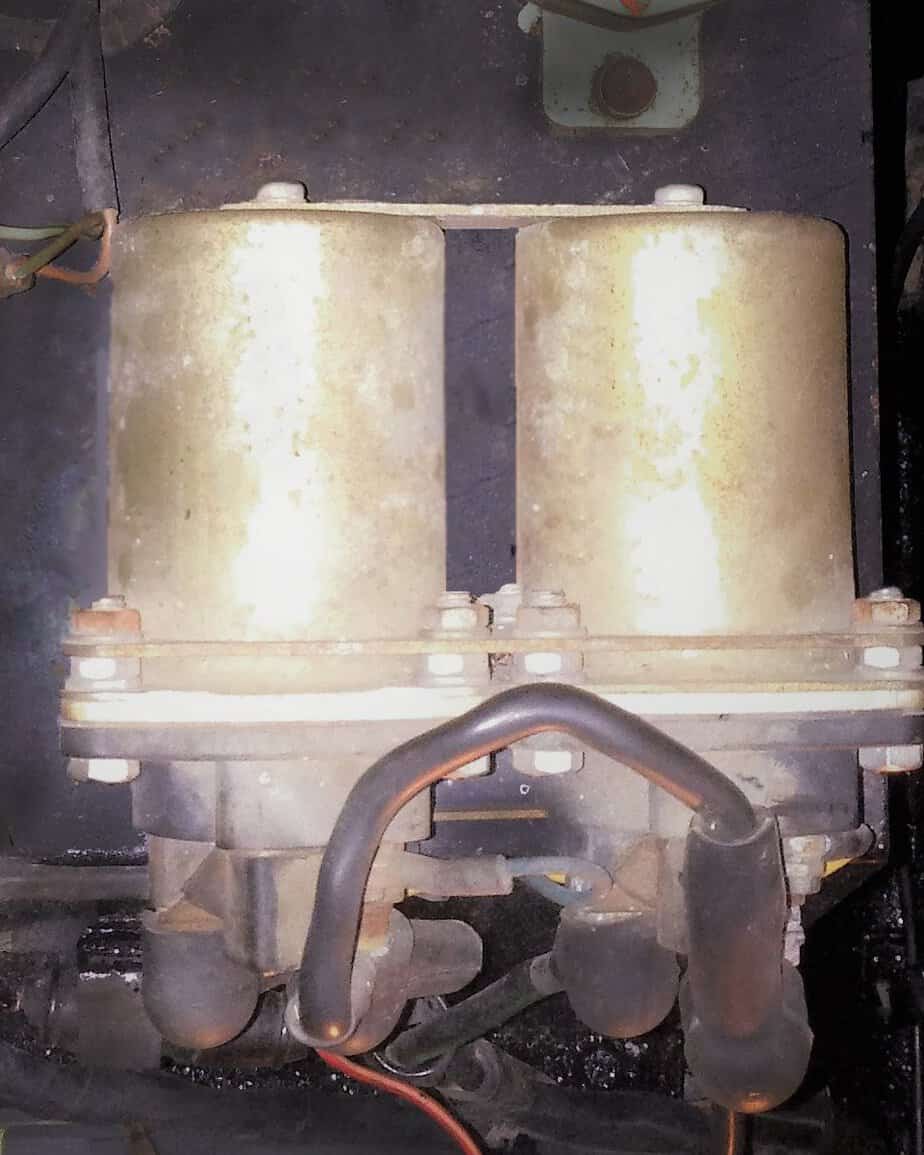
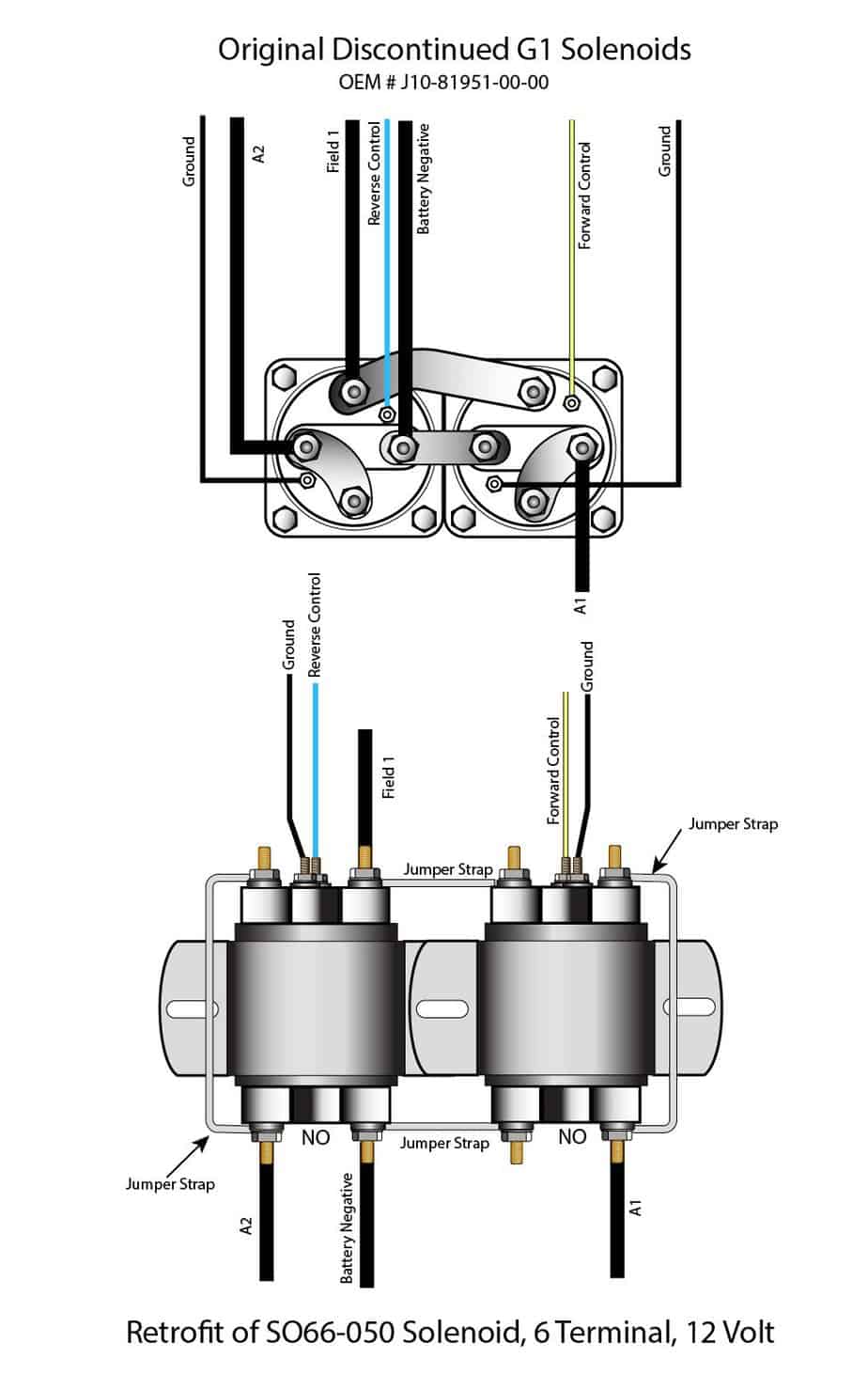
All original G1 solenoids, on both gas and electric models, used a single-end terminal configuration with all connection points on one end of the unit. These are no longer available from any manufacturer. The replacement solenoids available today use a two-end terminal configuration with large power terminals on one end and small coil terminals on the other. The retrofit wiring procedure is required to make the two-end replacement work correctly in place of the original single-end unit.
For the G1A gas model, the correct replacement is a 12V two-end terminal solenoid. For the G1E electric model, the correct replacement is a 36V two-end terminal solenoid. Both are available from Vintage Golf Cart Parts, which maintains stock specifically for G1 models. Do not substitute a generic automotive solenoid, the coil voltage must match the cart’s system voltage or the solenoid will fail immediately or not energize correctly.
The image below shows the original single-end style solenoid alongside the retrofit wiring diagram for the gas model. Follow this diagram exactly when installing the two-end replacement. The retrofit changes which terminals the original wires connect to and adds a bridging wire between specific terminals on the new unit.
G1A Gas Model Solenoid Retrofit Wiring Diagram
G1E Electric Model Solenoid Retrofit Wiring Diagram
The G1E retrofit follows the same principle as the gas model but uses the 36V replacement solenoid. The diagram below shows the correct terminal connections for the forward and reverse solenoids on the electric model.
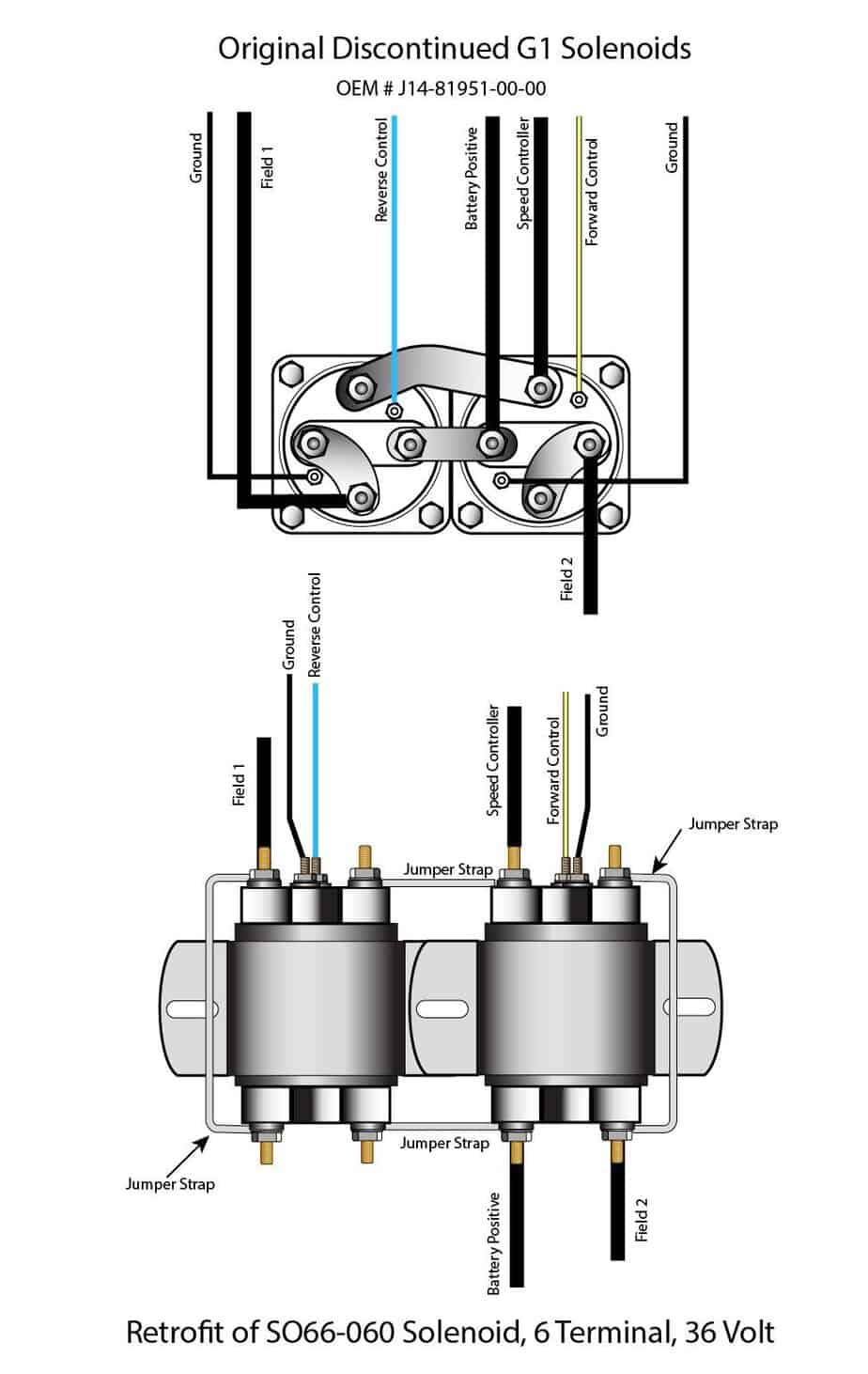
Two-end terminal replacement for original single-end G1E solenoid. Use for both forward and reverse solenoid positions. Confirm 36V coil voltage before ordering.
View at Vintage Golf Cart Parts →
Two-end terminal replacement for original single-end G1A gas solenoid. 12V coil voltage, do not substitute on electric model.
View at Vintage Golf Cart Parts →
Yamaha G1 Solenoid Wiring: G1A Gas Model Wiring Diagrams
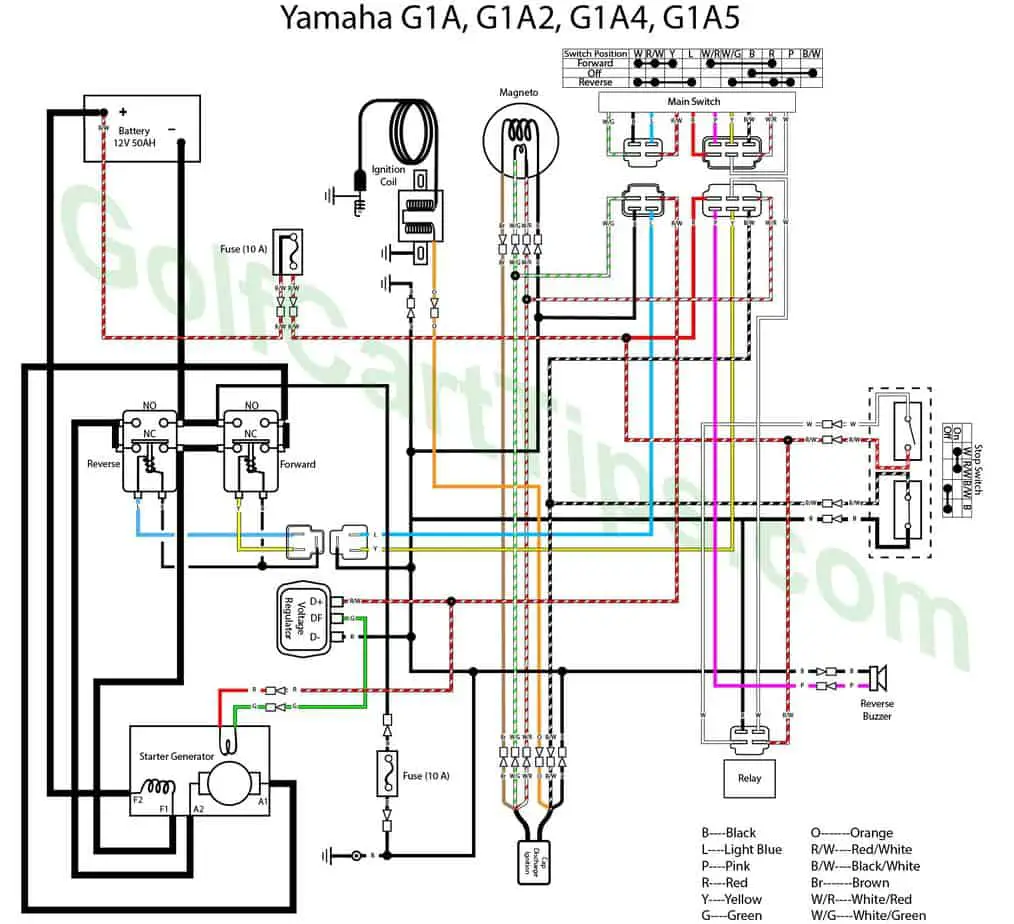
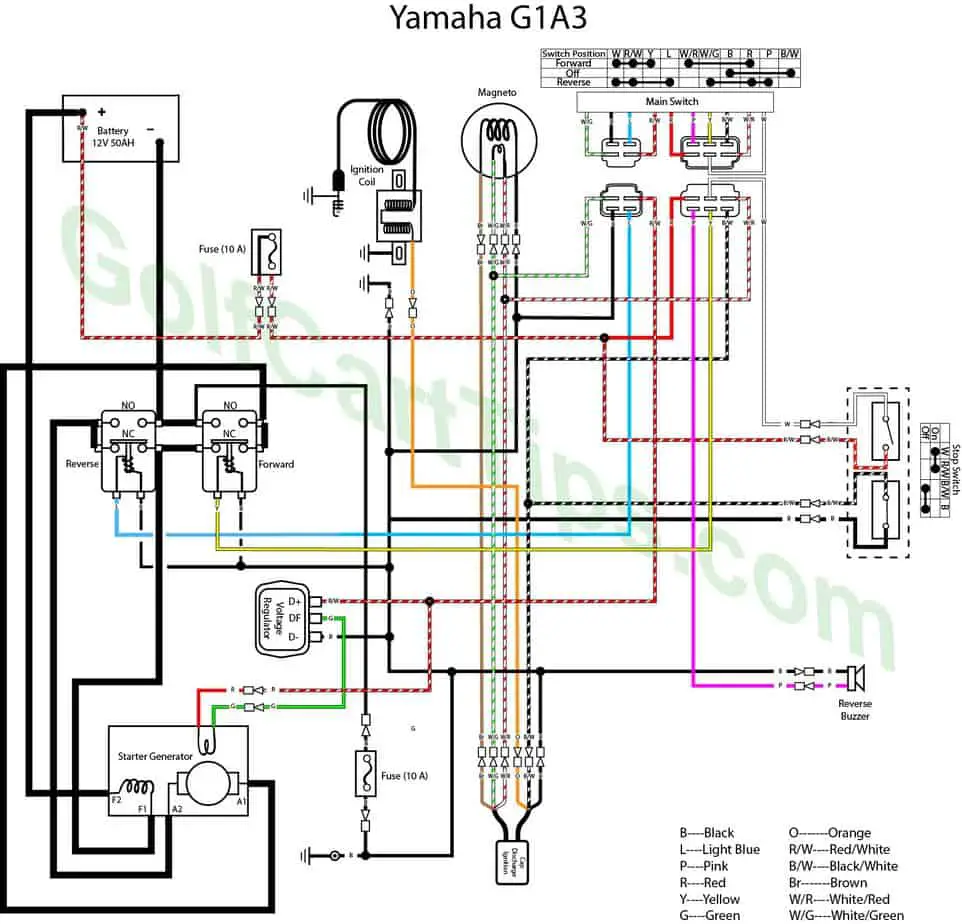
The G1A gas model was produced from 1979 through 1989 with minor variations across years. The G1A, A2, A4, and A5 variants produced in 1979 to 1981 and 1983 to 1989 share the same basic wiring diagram. The G1A3 produced in 1982 uses a slightly different ignition circuit and has its own diagram. Use the correct diagram for your specific year. Confirm your year using the serial number decode guide at What Year Is My Yamaha Golf Cart if you are unsure.
G1A, A2, A4, A5 Gas Models 1979-81 and 1983-89
G1A3 Gas Model 1982
Yamaha G1 Solenoid Wiring: G1A Gas Troubleshooting Chart
The table below covers the most common symptoms on the G1A gas model with their most likely causes and corrective steps. Work through the corrective steps in the order listed before replacing components. Most G1A starting failures trace back to the battery, ignition wiring, or carburetor rather than the solenoid itself.
| Symptom | Possible Cause | Corrective Steps |
|---|---|---|
| Engine Will Not Turn Over | Battery not charged | Test and recharge |
| Poor terminal connection | Clean and tighten | |
| Bad starter motor | Test, repair or replace | |
| Engine Turns Over, Will Not Start | Moisture on ignition wires and spark plug cap | Wipe wires and cap clean and dry |
| Faulty ignition cables | Replace any cracked or shorted cables | |
| Open or shorted primary ignition circuit | Trace primary ignition circuit and repair | |
| Faulty coil | Test and replace if necessary | |
| Dirt or water in fuel line or carburetor | Clean lines and carburetor, replace filter | |
| Carburetor flooded or float setting incorrect | Adjust float level and check seats | |
| Loss of Power | Dirt or water in fuel line, carburetor or filter | Clean lines, carburetor and replace filter |
| Incorrect ignition timing | Reset timing | |
| Dirty or incorrectly gapped spark plug | Clean plug and set gap, replace if necessary | |
| Engine Stalls | Incorrect choke adjustment | Adjust choke |
| Idle speed set too low | Adjust idle speed on choke | |
| Incorrect carburetor float setting | Adjust float setting | |
| Faulty ignition wiring | Trace out and correct | |
| Dirty or incorrectly gapped spark plug | Clean plug and set gap | |
| Contaminants in fuel line or carburetor | Clean lines, carburetor and replace filter | |
| Faulty coil | Check and replace |
Yamaha G1 Solenoid Wiring: G1E Electric Model Wiring Diagram and Component List
The G1E electric model was produced from 1980 through 1986. It runs on a 36V pack of six 6V batteries in series and uses a resistor coil speed controller rather than a modern PWM controller. The full wiring diagram for the G1E is shown below, followed by the complete component list and the system state for the key-off rest position.
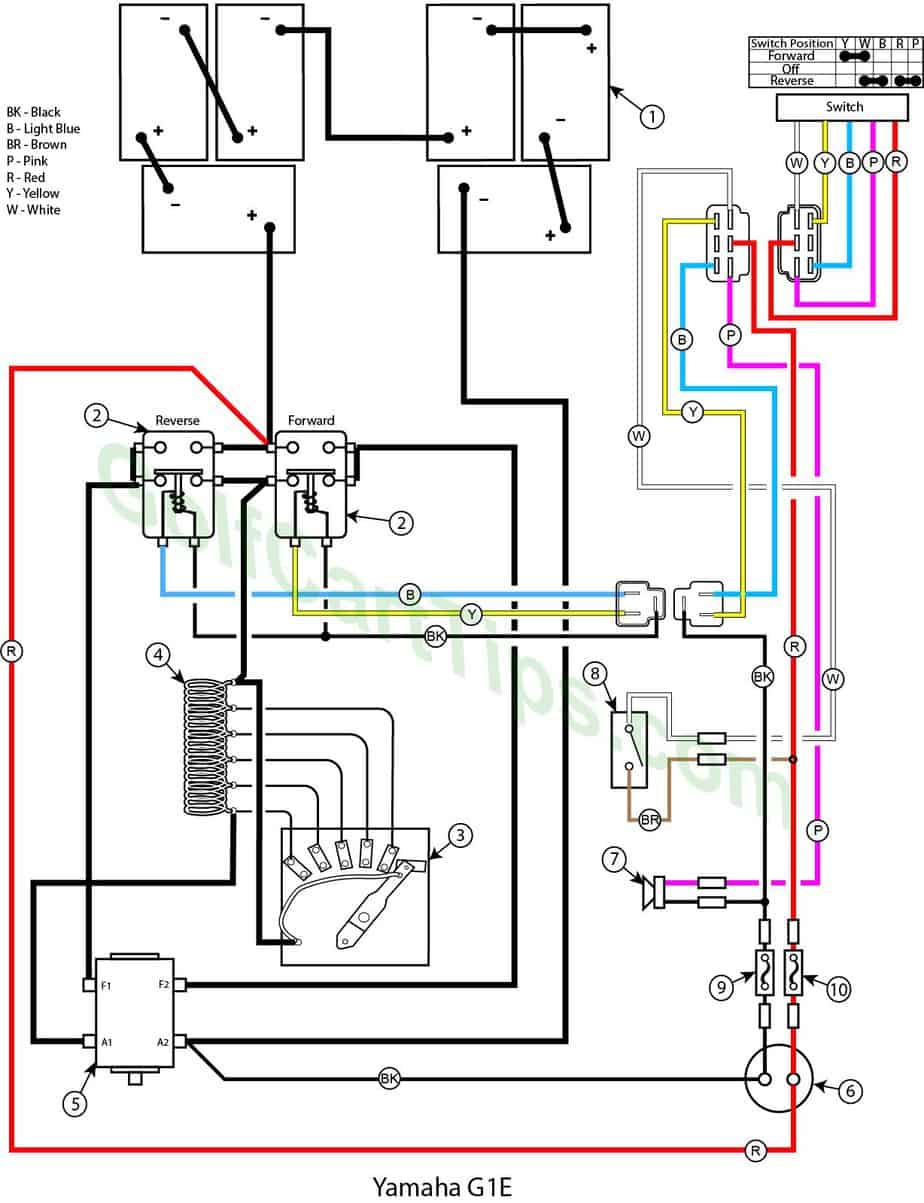
G1E Component List
- Batteries, 6 x 6V in series (36V total)
- Solenoid Relay (forward)
- Speed Controller
- Resistor Coil
- Traction Motor
- Charge Receptacle
- Back Up Buzzer
- Stop Switch (at pedal)
- 10 amp Fuse
- 10 amp Fuse
G1E System State: Key Off, Rest Position
The wiper arm is at full rest and making contact with Contact Terminal 1. All solenoids are de-energized. No voltage flows to the motor. This is the normal rest state for a key-off G1E. If any solenoid is energized with the key off, there is a wiring fault or a stuck key switch.
- Key switch: Off
- Speed Controller: At Contact 1
- Forward Solenoid: Not energized
- Reverse Solenoid: Not energized
- Voltage to Motor: None
- Voltage across A1 and A2: None
- Voltage across F1 and F2: None
- Stop Switch: Open state
Yamaha G1 Solenoid Wiring: G1E Power Flow Logic Diagrams
The power flow logic diagrams below show the system state at each operating condition. Use these to trace faults at a specific speed or direction. If the cart operates at one speed but not another, compare the system state for the working condition against the non-working condition, the difference points directly to the faulty component.
Forward 1st Speed
The wiper arm is making contact with Contact Terminal 1 and the pedal is slightly pressed. Current flows through the full resistor coil, which limits motor voltage to the lowest speed setting.
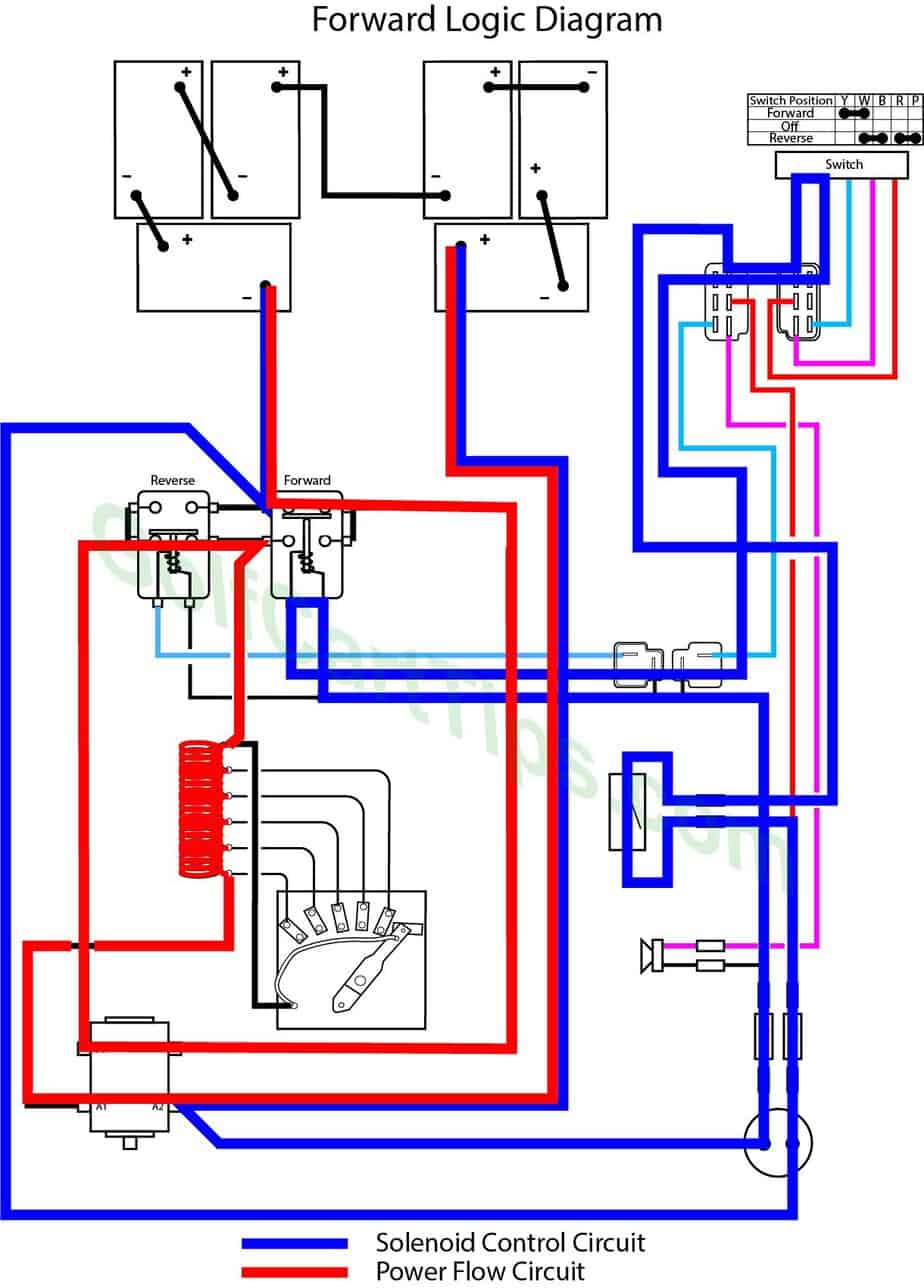
- Key switch: Forward
- Speed Controller: At Contact 1
- Forward Solenoid: Energized
- Reverse Solenoid: Not energized
- Voltage to Motor: Present
- Voltage: Across full resistor coil
- Stop Switch: Closed state
Forward 2nd Speed
The wiper arm has moved to Contact Terminal 2. Current bypasses one fifth of the resistor coil, which increases voltage to the motor and raises speed. If the cart runs correctly at 1st speed but fails at 2nd, the fault is at Contact Terminal 2 or in the wiring to it.
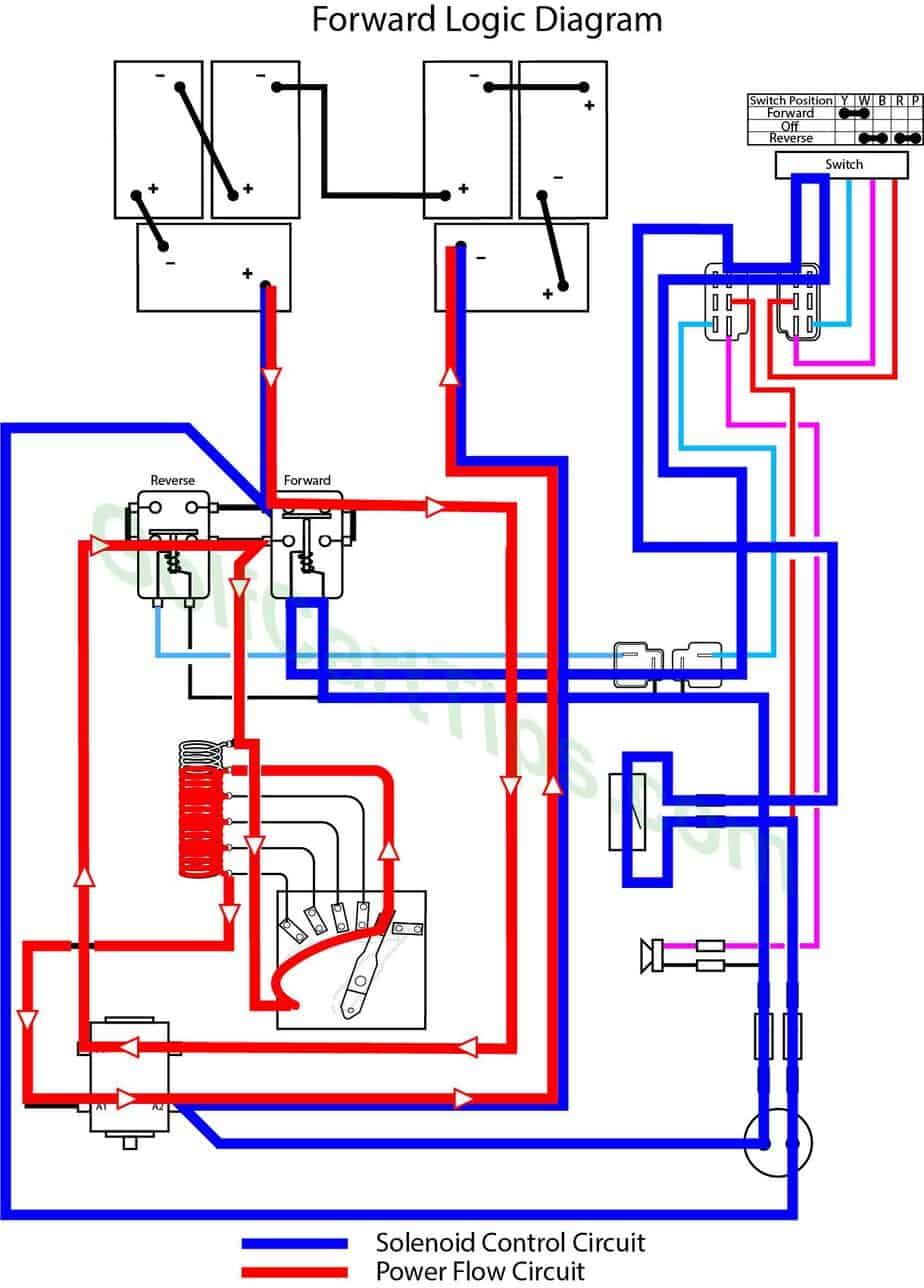
- Key switch: Forward
- Speed Controller: At Contact 2
- Forward Solenoid: Energized
- Reverse Solenoid: Not energized
- Voltage to Motor: Present
- Voltage: Across 4/5 of resistor coil
- Stop Switch: Closed state
Reverse 2nd Speed
The key switch is in Reverse. The reverse solenoid energizes, which reverses the current direction through the motor field coils F1 and F2. The motor shaft reverses direction. The back-up buzzer energizes simultaneously. If the cart moves forward in Reverse, F1 and F2 are wired backwards, swap those two field coil connections.
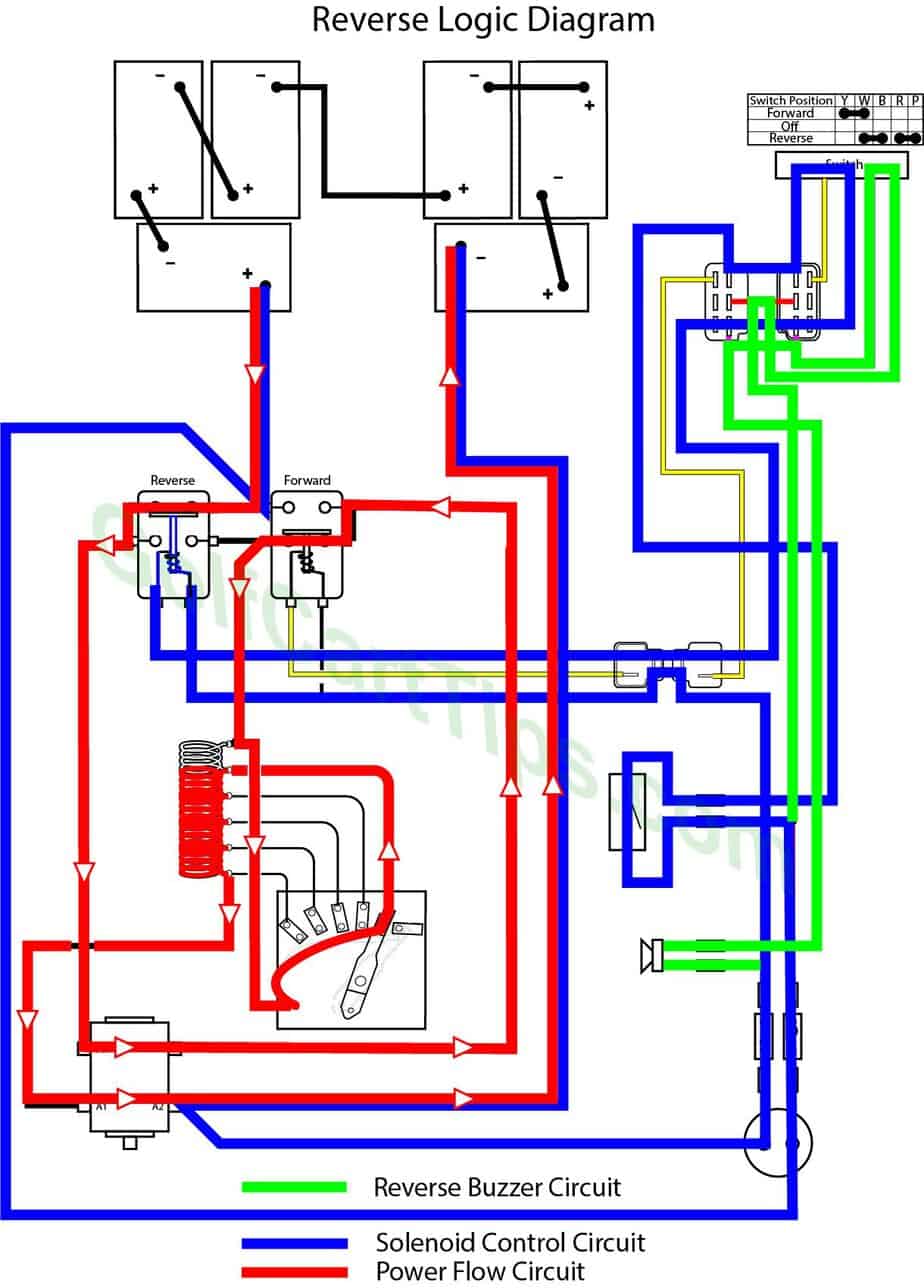
- Key switch: Reverse
- Speed Controller: At Contact 2
- Forward Solenoid: Not energized
- Reverse Solenoid: Energized
- Voltage to Motor: F1 and F2 flow reversed
- Voltage: Across 4/5 of resistor coil
- Stop Switch: Closed state
- Reverse buzzer: Energized
Yamaha G1 Solenoid Wiring: G1E Controller Exploded View
The exploded view below shows the internal components of the G1E speed controller assembly. Use this diagram when inspecting the wiper arm contact, resistor coil connections, and contact terminal positions. Burnt or corroded contact terminals are a common cause of missing speed positions on G1E carts.
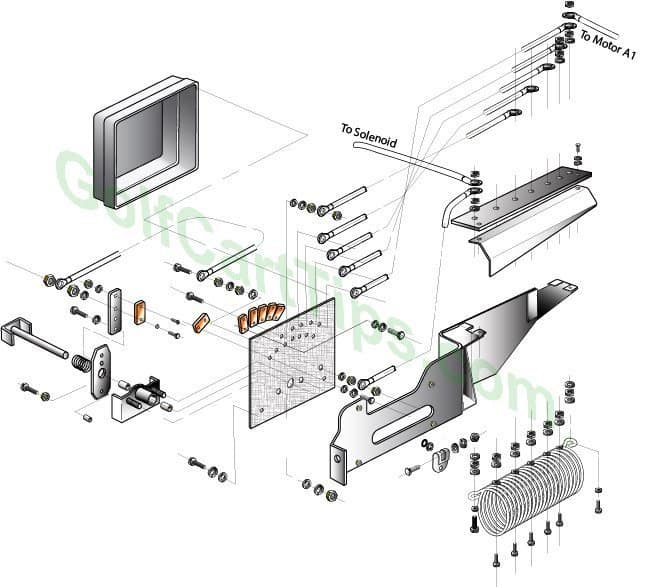
Yamaha G1 Solenoid Wiring: G1E Electric Troubleshooting Chart
The table below covers the most common symptoms on the G1E electric model. Before using this table, confirm the battery pack is fully charged and all terminal connections are clean and tight. A discharged or imbalanced pack produces symptoms that look like motor or controller faults.
| Symptom | Possible Cause | Corrective Steps |
|---|---|---|
| Motor Will Not Turn | Motor terminals loose or corroded | Tighten or clean terminals |
| Brushes not contacting the commutator | Adjust brush position | |
| Lead wires faulty | Check continuity, test, repair or replace | |
| Field coil broken | Repair or replace | |
| Armature coil broken | Repair or replace | |
| Motor Turns Slowly | Terminals loose or corroded | Check terminals, clean and tighten |
| Accelerator arm movement restricted | Adjust linkage | |
| Leads partially broken or loose | Check for loose wire strands, replace if defective | |
| Bearings Overheating | Bearings worn or low on grease | Replace bearings |
| Bearings not installed correctly | Adjust bearing installation | |
| Noisy Motor Operation | Mounting bolts loose | Tighten mounting bolts |
| Bearing failure | Replace bearings | |
| Bearings dirty | Replace bearings | |
| Bearings run out of grease | Replace bearings | |
| Dirt or foreign material in motor case | Clean motor | |
| Motor Vibration | Armature out of round | Replace armature |
| Motor mounting bolts loose | Retighten mounting bolts |
Yamaha G1 Solenoid Wiring: Common Issues and What to Check First
The most common wiring problems on both G1A and G1E models fall into five categories: corrosion at terminal connections, frayed or broken wires from age and vibration, incorrect wire routing after a previous repair, loose connections at the solenoid terminals, and overloaded circuits from non-stock accessories. On a cart that is 35 to 45 years old, any of these can be present simultaneously.
A digital multimeter is the essential tool for diagnosing G1 wiring problems. Check voltage at the solenoid input terminals with the key on to confirm battery voltage is reaching the solenoid. Check voltage at the solenoid output terminals with the solenoid energized to confirm it is passing voltage through. Check resistance across the solenoid coil terminals to confirm the coil is intact. A coil reading open circuit (infinite resistance) means the solenoid coil has burned out and the unit needs replacement.
For intermittent faults that come and go with vibration or temperature, inspect every terminal connection on the affected circuit while gently wiggling the wire. A connection that causes the symptom to appear or disappear when moved is the fault location. On G1E carts, pay particular attention to the resistor coil terminal connections, which are subject to heat cycling and vibration and develop high-resistance connections that cause speed step failures without completely breaking continuity.
| Problem | Cause | Solution |
|---|---|---|
| Corrosion at terminals | Moisture exposure over decades of use | Clean with baking soda solution and wire brush, apply terminal protector |
| Frayed wires | Age, vibration, or mechanical damage | Replace the affected wire with correct gauge |
| Incorrect routing | Previous repair without reference to diagram | Refer to wiring diagram and correct the routing |
| Loose solenoid connections | Vibration, original installation loosening over time | Torque to snug, do not overtighten brass terminals |
| Overloaded circuit | Aftermarket accessories pulling more current than fuse rating | Use components rated for correct voltage and current |
Yamaha G1 Solenoid Wiring: Tools Needed
A digital multimeter is the most important tool for G1 solenoid wiring diagnosis. It handles voltage testing at solenoid terminals, continuity testing through wiring runs, and coil resistance testing to confirm solenoid coil integrity. Wire strippers and crimpers are needed for preparing and terminating replacement wire. Assorted screwdrivers and wrenches cover solenoid removal and reinstallation on both models.
Replacement wire should match the gauge of the original. Most main circuit wires on the G1E are 10 to 12 AWG. A soldering iron and heat-shrink tubing provide the most durable repairs on wire joints that will be exposed to vibration and moisture for another decade of service.
Essential for voltage, continuity, and resistance testing on G1A and G1E circuits. Auto-ranging preferred for working across 12V and 36V systems.
View on Amazon →

Frequently Asked Questions About Yamaha G1 Solenoid Wiring
How do I know if my Yamaha G1 solenoid is faulty?
On the G1A gas model, a faulty solenoid prevents the engine from cranking when the key is turned. You will hear no click and no starter engagement. On the G1E electric model, a faulty forward solenoid prevents the cart from moving forward, you may hear a click from the solenoid coil energizing but the main contact is not closing. The bypass test confirms it: bridge the two large solenoid terminals with a jumper wire while the key is in Forward and the pedal is pressed. If the motor runs, the solenoid main contact has failed.
Can I replace the G1 solenoid myself?
Yes, with basic mechanical and electrical skills. The critical requirement is using the retrofit wiring diagram shown above, because the original single-end terminal solenoid is no longer available and the two-end replacement requires a different terminal connection arrangement. Disconnect the battery pack before starting any work on a G1E electric cart. Confirm the replacement solenoid voltage matches your cart, 12V for G1A gas, 36V for G1E electric.
Why does my G1E run at one speed but not another?
The G1E uses a resistor coil speed controller with discrete contact positions. Each speed position connects the motor through a different portion of the resistor coil. A fault at a specific speed position is usually a burnt or corroded contact terminal in the controller assembly, a broken wire to that terminal, or a failed solenoid associated with that speed position. Pull the controller cover and inspect the contact terminals visually for burning or corrosion. Compare the system state table for the working and non-working speeds to identify which component the fault isolates to.
My G1E moves forward when I select reverse, what is wrong?
The motor field coil connections F1 and F2 are reversed. When the reverse solenoid energizes, it reverses current through the field coils to reverse the motor direction. If those wires were connected incorrectly during a previous repair, energizing the reverse solenoid actually drives the cart forward. Swap the F1 and F2 connections at the motor terminals and retest.
Where can I get Yamaha G1 solenoid replacements?
Vintage Golf Cart Parts at vintagegolfcartparts.com is the most reliable source for G1-specific solenoid replacements. They stock both the 12V replacement for the G1A gas model and the 36V replacement for the G1E electric model, along with the wiring information for the retrofit. General automotive solenoids are not direct replacements and should not be substituted without confirming coil voltage compatibility.
About the Author
Chuck Wilson spent decades as a golf cart and small vehicle mechanic before retiring. His shop work covered Club Car, EZGO, and Yamaha platforms across gas and electric drivetrains, including vintage G1 models. He runs GolfCartTips.com in retirement, writing about repairs and maintenance based on jobs he has actually done, not manufacturer talking points. If a procedure is on this site, it has been performed on a real cart.
Last verified on: Yamaha G1A gas 1979-89, Yamaha G1E electric 1980-86. Solenoid retrofit procedure confirmed against Vintage Golf Cart Parts documentation. Wiring diagrams sourced from original Yamaha G1 service manual.